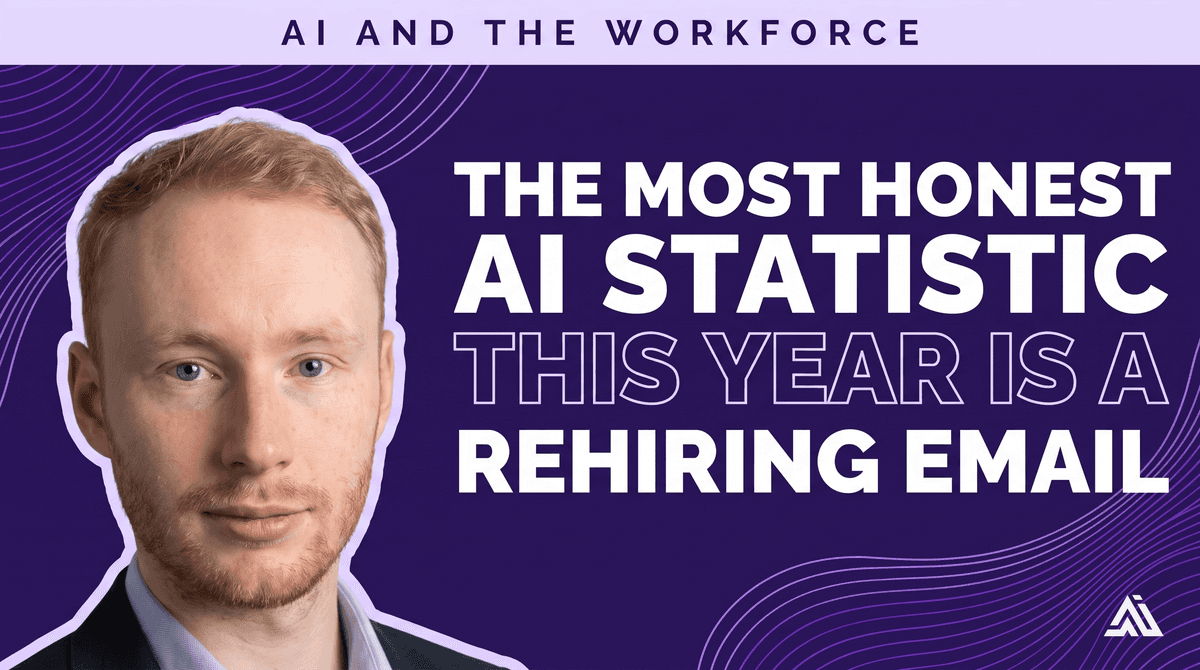
The most honest AI statistic this year is a rehiring email
By AssumeAI · Published Sep 30, 2026 · Updated Oct 8, 2026
In late September, Amazon's cloud division began quietly emailing some of the thirty thousand people it had laid off this year, asking whether they might like to discuss open roles in artificial intelligence and cloud computing. Recruiters called it the Swami's Boomerang Reengagement Initiative, after the AWS vice president who oversees it, and it produced one of the more honest statistics this year's AI layoffs have generated: the rate at which a company asks its own redundancies to come back.
It would be wrong to read this as evidence that artificial intelligence cannot do real work. Amazon, like Salesforce and Google, is genuinely integrating agents into workflows that used to require people, and it is competing hard, with Google, OpenAI, Meta and Anthropic, for staff who can build and run those systems. The capability is not fictional, and a business that dismisses this wave of automation as a rerun of past hype cycles makes the same mistake in the opposite direction. The case here is not that AI substitution is a myth.
The trouble is narrower. Many of this year's headcount decisions were made on the promise of that capability, not on evidence that a particular deployment, in a particular workflow, could sustain it. Klarna is the case study everyone already half remembers. In 2024 its chief executive credited a customer service bot with work equivalent to seven hundred full-time agents and projected forty million dollars a year in savings. By early this year the company was quietly rebuilding its human team, because the system handled routine queries well and multi-step disputes, fraud cases and escalated complaints badly, and unwinding the failed automation cost more than it had saved.
The scepticism is loudest where the claim is easiest to check against day to day work. When GitLab cut seven per cent of its workforce in May and called it an investment in the agentic era rather than a cost reduction, the developers who actually use the product were unconvinced. Several pointed out on Hacker News that the share price had fallen by half over the preceding year, and one summarised the real constraint bluntly: the bottleneck is decision making, and AI is bad at that. A framing built for investors and a framing that would survive contact with the backlog are not always the same framing.
The aggregate data now agree with the sceptics. Gartner's survey of three hundred and fifty companies with revenues above a billion dollars, published in May, found that eighty per cent had cut headcount after deploying AI, with no correlation between the size of the cut and any improvement in return on investment; the firms with the strongest returns were amplifying their staff, not replacing them. Challenger, Gray and Christmas's monthly tally supplies a quieter version of the same point. Artificial intelligence led every stated reason for layoffs from March through July, then in August fell to fourth place behind plain restructuring, the least glamorous explanation a company can give. A stated reason that unwinds that fast was doing rhetorical work, not descriptive work.
Economists at Stanford's Institute for Economic Policy Research went looking for the aggregate employment effect directly and mostly could not find it. Only five per cent of firms report any employment impact from AI adoption, and what remains sits alongside explanations that have nothing to do with model capability, among them interest rate rises that predate ChatGPT and a correction from pandemic-era over-hiring. The one clear casualty in their data is recent graduates in AI-exposed fields, whose unemployment reached five point six per cent early this year, up one point six percentage points on three years earlier, a narrower finding than the industry-wide story built on top of it.
None of this means the AI-exposed roles are safe, or that the technology stays where it is today. It means the decision quality behind this year's layoffs has lagged the confidence with which they were announced, which is why Forrester now expects roughly half of them to be reversed, with more than a third of the reversing firms rehiring over half the people they let go. A business weighing the same cut should ask a narrower question than whether AI can plausibly do the work. It should ask what evidence, from this deployment, in this workflow, shows that it already does. Amazon's recruiters are, in effect, asking the same question about the people it just let go.