
AI consulting for professional services firms.
AI consulting for professional services firms covers three things: an AI strategy that shows where AI pays back in your firm, the governance that keeps client data and professional obligations safe, and the AI development that puts working systems into everyday use. AssumeAI is a UK, founder-led AI consultancy and AI engineering firm that delivers all three, at published prices from £3,000. We start with where the hours go, put the safeguards in place, and only then build.
- Hours a year found in one two-week review
- 9,672
- Hours a month saved at The Litmus Partnership
- 268
- New provisions found against the RICS standard
- 12
- Published prices, from
- £3,000
Firms we have built with













What does AI consulting for professional services involve?
Professional services firms sell judgement, and they are trusted with information their clients would share with nobody else. Both facts shape how AI should be adopted. The opportunity sits in the preparing, checking, re-keying and reporting that surrounds the judgement, which is work AI can take on. The constraint is just as real: a firm that answers to clients, auditors and a chartered or professional body cannot let its people paste client material into whichever tool they found last week.
Our work follows that order. We typically start with an AI Strategy Review to find the best return, set priorities and reduce risk, through stakeholder interviews, organisational analysis and a governance check. Next we put governance and safeguards in place: clear policies, controls and training, so your team can use AI safely and consistently. Then we design and build production-grade AI that works in real environments. Nothing is built without justification and nothing is deployed without safeguards.
AssumeAI sits between the strategy firms that cannot build and the AI development firms that cannot advise. The same team that writes your plan can deliver it, and the plan is written by people who know what is buildable, because our work is grounded in production-level engineering.
- Step 01
Find and cost
Where the hours go, with a cost against each opportunity, ranked.
- Step 02
Govern
Policies, controls and training, so AI is used safely and consistently.
- Step 03
Build
Production-grade AI, built inside your firm and owned by you.
Why do professional services firms stall on AI?
Rarely for lack of interest. More often, one of four things has happened. People are already using consumer AI tools with company data, nobody signed that off, and leadership cannot see what goes where. A blanket ban looked like the safe answer, but it only pushes usage underground. The firm bought licences and nothing changed, because without the workflows built nobody knew what to do with them. Or the firm looked seriously at Claude or ChatGPT for the business and stalled on data, hosting and governance.
Behind most of these sits the same gap: there is nobody in house who can build. The barrier is rarely the money. That is usually the whole reason firms of 20 to 200 people have not started, and it is the part we take on. Afterwards we train your team, hand over the documentation and leave you a roadmap you can run without us, because we do not want you dependent on us.
The free AI maturity assessment is a quick way to see where your firm stands. It is nine questions and about two minutes, built for professional services firms of 20 to 200 staff, and benchmarked against comparable firms, with the scored report in your inbox immediately.
- Consumer tools, used with client data
- A blanket ban that pushed it underground
- Licences bought, and nothing changed
- Stalled on data, hosting and governance
How do you keep client data and professional obligations safe?
Governance is the part of AI adoption that is most specific to professional services, and it is where we start whenever a firm handles client or regulated data. No two firms operate under quite the same obligations, so the templates online rarely fit.
AI governance implementation produces internal AI policies for your teams, external AI policies for clients and partners, impact assessments for what you deploy, and audit trails including a risk register and an incident log. It is aligned with EU GDPR, any SOC credentials you need to hold and the requirements of your chartered or professional bodies. It typically takes two to four weeks and starts from £3,000.
Our governance work for Hillbreak shows what that looks like in a regulated profession. The RICS professional standard on the responsible use of AI in surveying practice took effect on 9 March 2026 and introduced specific, documented obligations. Hillbreak's existing policy was principles-based and a solid foundation. We assessed it against the standard, identified twelve new provisions and prepared a nine-document pack, taking the updated policy from four rules to thirteen. A later impact assessment workshop completed a worked example of all nine sections of the template together, with every risk rated before and after mitigation, so the team can carry out assessments themselves.
On the data itself, we do not build on top of your business, we build inside it. Everything lives in your existing infrastructure and you own all of it.
Describe the defined business use case for this tool. What problem does it solve, and what outputs will it produce?
| Non-AI alternatives considered | |
|---|---|
| Why AI is more appropriate than alternatives | |
| Is this use of AI proportionate to the task? |
 Governance pack · Template
AI Tool Impact Assessment
Complete one per AI tool. Retain as a governance record.
| Tool name | |
|---|---|
| Vendor or provider | |
| Version or model | |
| Date of assessment | |
| Assessor | |
| Business owner | |
| Date of first use | |
| Next review date |
- Built inside your infrastructure
- You own all of it, code included
- EU-based data hosting
- GDPR, SOC and professional bodies
What does an AI strategy for a professional services firm contain?
A good AI strategy is evidence about your firm, not opinion about AI. Our AI Strategy Review takes about six weeks and is built from organisational surveys, interviews with the people doing the work, and a full review of your tech stack. It hands you five practical documents:
- An AI implementation roadmap, sequenced highest value first
- An AI risk assessment
- An AI readiness assessment, covering data, systems and cultural appetite
- An AI audit report
- An executive presentation to bring your leadership team with you
Reviews scale to the firm. Hillbreak, a specialist ESG and sustainability advisory firm for the real estate sector, wanted to increase delivery capacity without increasing headcount; over three weeks we mapped five functions and set out twenty-three initiatives in three phases. Coaching Without Borders, a Zurich-based coaching firm with twenty years of history, had a four-week review with six stakeholder interviews, six surveys and a full technology assessment, which produced twenty-seven initiatives across fifteen platforms. For The Litmus Partnership a two-week review identified 9,672 hours a year across twenty-six initiatives.
Jon Lovell, Hillbreak's founder, said we “took the time to understand our business, including our purpose, values, operating model and distinct value propositions”. If six weeks is more than you need, the AI Priorities Workshop gives you two pain point workshops and a concise roadmap, from £4,000.
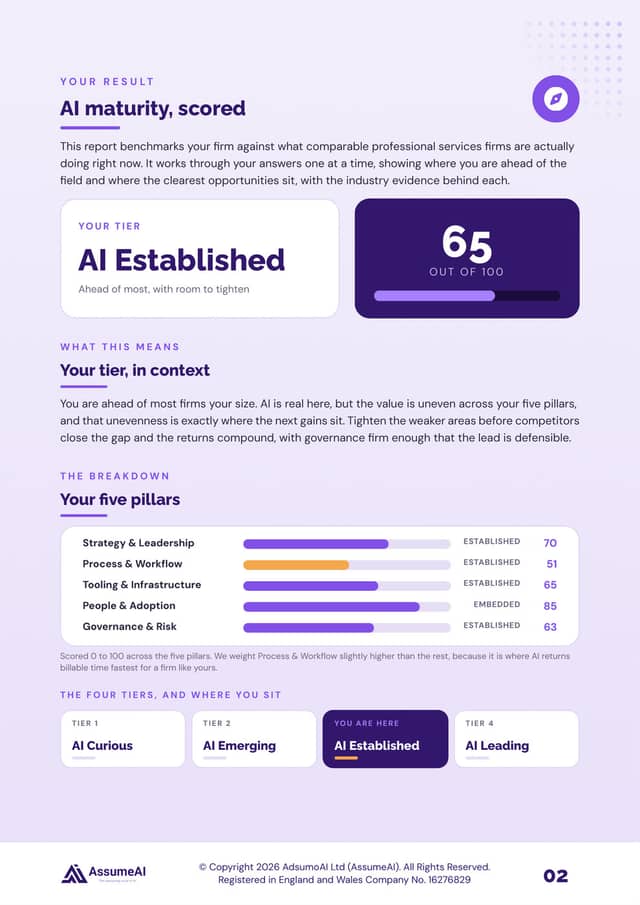
- AI implementation roadmap
- AI risk assessment
- AI readiness assessment
- AI audit report

Hillbreak
“We engaged AssumeAI to review and provide recommendations on the optimisation of AI and automation solutions for our firm, both in relation to our business operations and our client services.
They took the time to understand our business, including our purpose, values, operating model and distinct value propositions, and they engaged with our whole team with professionalism and integrity.
We were really impressed with the work they did, and the way they went about doing it.”
Where does AI development pay back in professional services?
Once the priorities are clear, AI development for professional services firms tends to land in three places: the work that wins clients, the work that delivers for them, and the work that runs the firm.
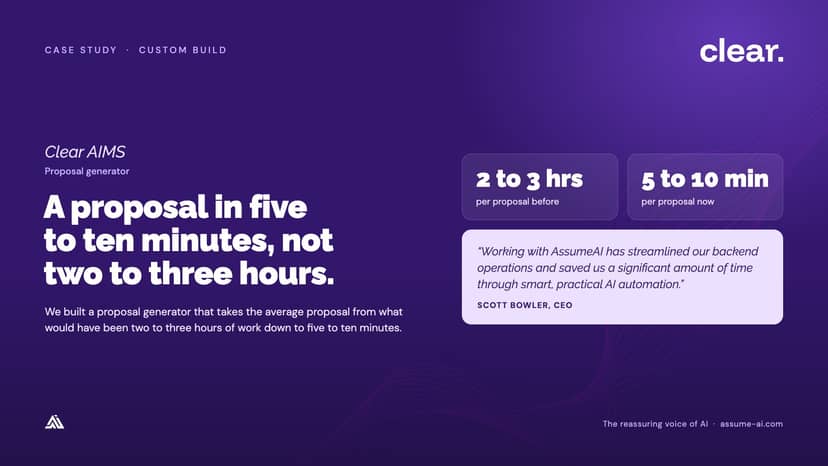
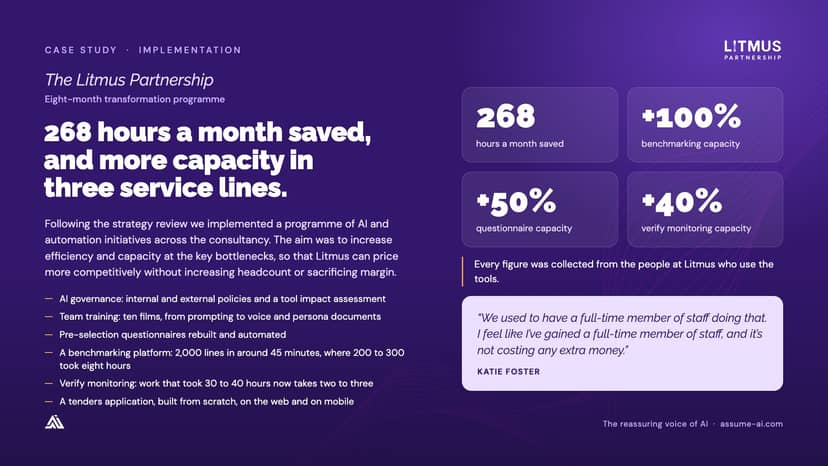
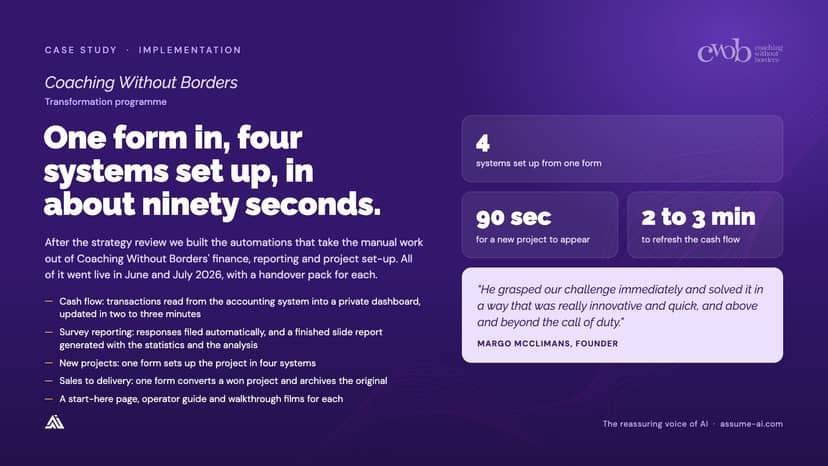
Winning work: the proposal generator we built for Clear AIMS takes the average proposal from two to three hours of work to five to ten minutes. Delivering work: at The Litmus Partnership, a benchmarking platform handles 2,000 lines in around 45 minutes where 200 to 300 took eight hours, and across an eight-month programme the firm now saves 268 hours a month. Running the firm: at Coaching Without Borders, one form sets up a new project in four systems in about ninety seconds, and the cash flow dashboard refreshes in two to three minutes.
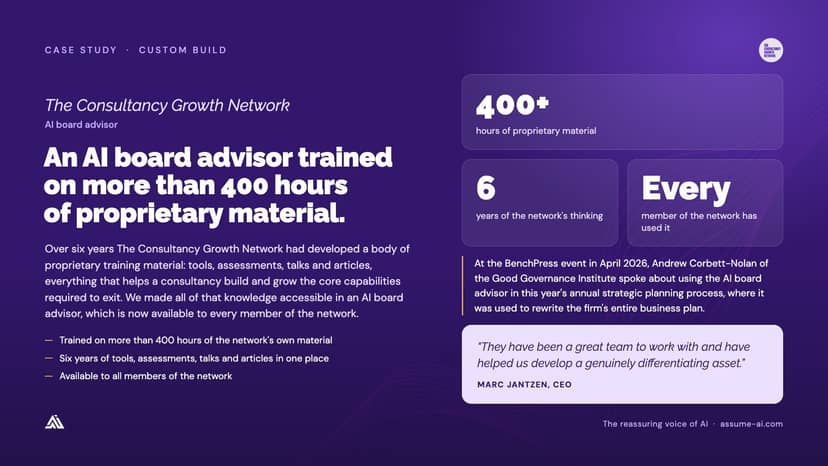
There is a fourth place that matters to firms built on expertise: the knowledge itself. The Consultancy Growth Network's AI board advisor is trained on more than 400 hours of the network's proprietary material, six years of tools, assessments, talks and articles, and it is available to every member of the network.
Every build ends with a handover. At Coaching Without Borders that meant a start-here page, an operator guide and walkthrough films for each automation, so the systems belong to the firm rather than to us. You can see every project on our work page.
Build, buy or train?
For most firms the answer is a sequence rather than a choice.
Train
Train first if your people have the tools but are not getting value from them. Tailored AI team training covers Claude, Cowork, Gemini and Prompt Engineering Fundamentals, built around your real work, from a single session to a sustained programme on our own platform, from £5,000. For Hillbreak, three Claude Cowork workshops came with six custom skills built for the team's own documents.
Buy
Buy, properly configured, if you want one secure platform for everyone. Enterprise AI Deployment is designed for firms of 20 to 200 employees: Claude Cowork or ChatGPT Enterprise on EU-based data hosting, configured to your data governance policies, with six to twelve agents and skills built around your real workflows, so your people open it on day one and the automated workflows are already there. It is £20,000 excluding VAT, with a full refund if you are not happy for any reason.
Build
Build when the work is specific to your firm and no product fits it. A 30-day sprint delivers one working automation, assistant or agent for one clear workflow. A 90-day sprint develops several solutions and embeds them. The managed service places half an engineer, one or two inside your firm on a monthly footing.
What does AI consulting cost for a professional services firm?
Every AssumeAI service has a published price. AI governance implementation starts from £3,000, the AI Priorities Workshop from £4,000, team training from £5,000, a 30-day sprint from £6,000, the AI Strategy Review from £12,000 and a 90-day sprint from £15,000. Enterprise AI Deployment is £20,000 excluding VAT, and that is the price, not a starting point. The managed service runs from £5,500 a month for half an engineer, £8,500 for one and £15,000 for two.
Those are starting points, not quotes for a build. We will not quote you before we know where your hours go, and neither should anyone else. The first step is finding where time is lost and putting a cost against each opportunity, ranked. You then sign off exactly what gets built, with the number and the return it is based on in front of you.
We are not the cheapest option, and if you want a quick hack we are the wrong firm. What we offer instead is a guarantee on every service. If a 30-day sprint is not live and delivering value in 30 days, for example, we keep working at no extra cost until it is.
| Service | Investment |
|---|---|
| AI Priorities WorkshopTwo pain point workshops and a concise roadmapTwo workshops, plus a roadmap | From £4,000 |
| AI Strategy ReviewSurveys, interviews, a tech stack review and five documentsAbout six weeks | From £12,000 |
| AI Governance ImplementationPolicies, impact assessments and audit trails2 to 4 weeks | From £3,000 |
| Tailored AI Team TrainingWorkshops across Claude, Cowork, Gemini and moreOne-off or a sustained programme | From £5,000 |
| 30-Day Implementation SprintOne use case, built and deployedAbout four weeks | From £6,000 |
| 90-Day Implementation SprintSeveral workflows built, deployed and embeddedAbout twelve weeks | From £15,000 |
| Enterprise AI DeploymentClaude Cowork or ChatGPT Enterprise, with six to twelve agents and skillsAgreed when scoped | £20,000 ex VAT |
| Managed ServiceHalf, one or two engineers embedded in your firmMonthly | From £5,500 per month |
How long does it take?
Governance work takes two to four weeks. The AI Priorities Workshop is two workshops and a roadmap. The AI Strategy Review takes about six weeks, depending on the size of the business, and focused reviews have run faster: two weeks for Litmus, three for Hillbreak, four for Coaching Without Borders. A 30-day sprint spends one week agreeing what to build and three weeks rolling it out. A 90-day sprint spends two weeks identifying, eight building and two embedding. Larger programmes are sequenced over months, as the eight-month Litmus programme was.
- AI governance implementation2 to 4 weeks
Policies and controls · Up to four weeks
- AI Strategy ReviewAbout six weeks; focused reviews in two to four
Surveys, interviews, tech stack
- 30-day implementation sprintAbout four weeks
Agree · Roll it out
- 90-day implementation sprintAbout twelve weeks
Prioritise · Develop and deploy · Embed
- A full programmeSequenced, not rushed
Eight months at The Litmus Partnership
How do you make AI stick once the engagement ends?
The aim of every engagement is a firm that no longer needs us for the work we did, and that shapes how we deliver. The 90-day sprint ends with two weeks spent embedding the capability in your team. Enterprise deployments come with documentation of every agent and skill, so your team can maintain and extend them. Governance work is designed for the team to run, which is why the Hillbreak workshop ended with a worked example they can repeat. And because you own the code, you are never locked in.
For firms that want capability to grow inside the business rather than arrive in a report, the managed service puts one of our engineers side by side with your people, transferring capability as the work happens. Benj Johns, CFO of Sladen Consulting, described working with us as “a partnership process, rather than a supplier and client process”.
- A start-here page and an operator guide
- Walkthrough films for each automation
- Documentation of every agent and skill
- Governance your team can run itself
- The code, which you own
Who is AssumeAI?
AssumeAI is a UK AI consultancy and AI engineering firm, founder-led from end to end. Rupert Wiseman, Managing Director, studied Law at Exeter and worked in corporate finance, and his legal background brings a rigorous focus on safety, governance and risk controls from day one. Hugh Dowling, Head of Development, completed a Master's in Software Engineering and makes sure what we build is designed to operate in a secure, scalable, commercial environment. Behind the founders is an associate network of over ten AI consultants and AI engineers.
We teach as well as build, including workshops at Green Templeton College, University of Oxford, on how AI is practically supporting consulting firms. Meet the team on our about page and read our weekly writing on the blog. If you run a consulting firm, our page on AI for consultancies goes further into that world.


Questions
Is it safe to use AI with confidential client data?
It can be, with the right platform and the right rules. We deploy enterprise platforms on EU-based data hosting, configured to your own data governance policies, and we build inside your existing infrastructure rather than on top of it. Internal and external AI policies, impact assessments and audit trails come first, and you own everything we build.
Do you cover the rules of our professional body?
Yes. Our governance work is tailored to your data, your clients, EU GDPR, any SOC credentials you hold and the requirements of your chartered or professional body. For Hillbreak we assessed its existing AI policy against the RICS standard on the responsible use of AI in surveying practice and prepared the documents that close the gaps.
Should we choose Claude or ChatGPT?
Either can work. We help you choose between Claude Cowork and ChatGPT Enterprise on the basis of your data governance requirements, the tools your firm already runs and the workflows you want automated. We then deploy whichever fits, with six to twelve agents and skills built around the work your teams actually do.
Do we need an AI strategy before we build anything?
It helps, but it is not essential. If you already know the bottleneck you want gone, a 30-day sprint spends its first week agreeing exactly what to build. If you are not sure where AI would pay off, a strategy review or a priorities workshop will stop you spending on the wrong things.
How much of our team's time will it take?
For a strategy review, some survey responses and a few short interviews; we do the heavy lifting. For the priorities workshop, your senior leadership for one session and the people doing the day-to-day work for the second. For a build, the people who will use the system test it with us before it goes live.