
Free AI resources for consultancies
Get to know AssumeAI.
The AI maturity assessment and the free training, then every film we have made: the service walkthroughs, the client stories, the Oxford sessions and the team. All of it free.
Read it in depth.
Long-form guides to AI strategy, governance, training and development for consultancies and professional services firms.
- AI by sector
AI for Consultancies and Consulting Firms
AI for consulting firms: AI strategy, governance, training and development for management, specialist and boutique consultancies, at published prices.
Read the guide - AI by sector
AI Consulting for Professional Services Firms
AI consulting for professional services firms: AI strategy, governance for client data and professional bodies, training and AI development. From £3,000.
Read the guide - AI development and automation
Claude vs ChatGPT Enterprise for Professional Services
Claude vs ChatGPT Enterprise for consultancies and professional services firms: data residency, admin, connectors and pricing, checked in October 2026.
Read the guide - AI strategy
AI Implementation Cost in the UK: A Budget Guide
What AI costs a UK professional services firm: consulting fees, build, licences and running costs, with worked first-year budgets at published prices.
Read the guide - AI governance
EU AI Act for Professional Services Firms: 2026 Guide
What the EU AI Act means for UK consultancies and professional services firms with EU clients: risk tiers, the Digital Omnibus dates and what to do now.
Read the guide - AI strategy
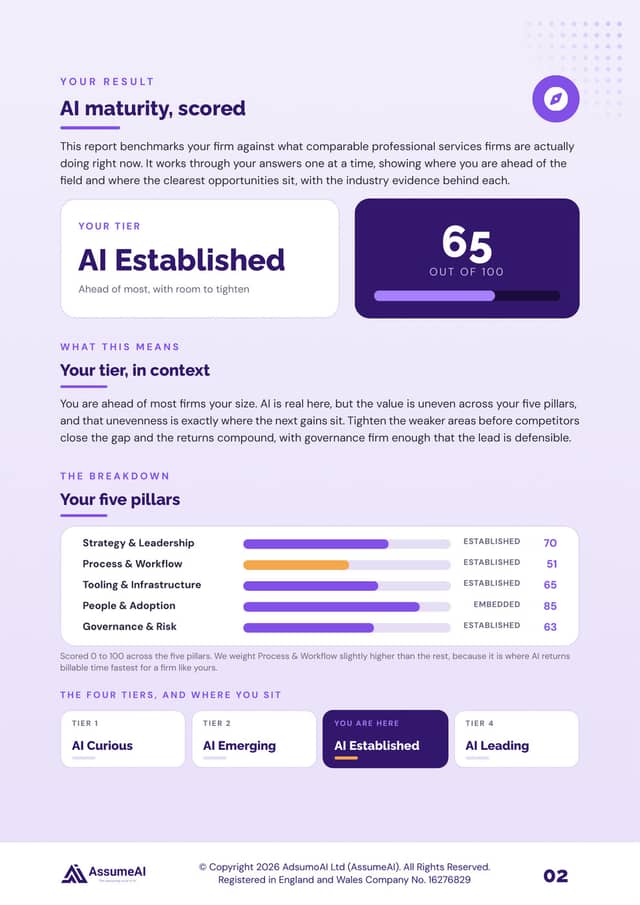
Free AI Maturity Assessment for Professional Services
Free AI maturity assessment for professional services firms: nine questions, two minutes, five pillars scored and a report in your inbox straight away.
Read the guide - AI by sector
AI for HR Consultancies: Uses, Risks and How to Start
AI for HR consultancies: policy drafting, employment law research with caveats, proposals and onboarding, and the UK GDPR rules for employee data.
Read the guide - AI strategy
RICS AI Standard: What Surveying Firms Must Do
The RICS standard on responsible use of AI in surveying, in force since 9 March 2026: what surveying firms must do, the records it needs and how to comply.
Read the guide - AI development and automation
AI Implementation Partner UK, or Hire an AI Engineer?
Choosing an AI implementation partner in the UK or hiring an AI engineer: real UK costs, what to ask before you sign, who owns the code, and what we build.
Read the guide - AI by sector
AI for Procurement Consultancies: A Practical Guide
AI for procurement consultancies: where it helps in spend analysis, tenders and bids, supplier research and contract review, the risks, and how to start.
Read the guide - AI by sector
AI for Management Consultancies: A Practical Guide
How management and boutique consultancies use AI to write proposals, speed up research, reuse their own knowledge and protect fees, with UK client results.
Read the guide - AI strategy
AI Proposal Writing for Consultancies, Done Safely
How consultancies use AI to write proposals faster and safely: reusing past proposals, protecting client data, checking every claim, with a worked example.
Read the guide - AI development and automation
AI Agents for Professional Services: A Practical Guide
What AI agents are in practice, where they work in consultancies and professional services firms, the risks and controls they need, and build vs buy.
Read the guide - AI training
AI Training for Staff in the UK: A Practical Guide
AI training for staff in the UK: the formats, what good training covers, how to measure it, what it costs, and how to make it stick in a professional firm.
Read the guide - AI strategy
Shadow AI and Client Data Security in Professional Services
Shadow AI in professional services firms: what it is, how to find it, and how to fix it with approved tools, an AI policy and training that protect client data.
Read the guide
How we work, in order.
Each one is a short film rather than a description. Review, then prioritise, then build, then hand over.
 Advisory
AI Priorities Workshop
Walkthrough film
 Advisory
AI Strategy Review
Walkthrough film
 Governance
AI Governance Implementation
Walkthrough film
 Training
Tailored AI Team Training
Walkthrough film
 Implementation
30-Day Implementation Sprint
Walkthrough film
 Implementation
90-Day Implementation Sprint
Walkthrough film
 Implementation
Managed Service
Walkthrough film
What actually changed.
Clients on what happened once the systems went in.
Where we teach and speak.
On AI risk, governance and the future of work, at the Oxford Frontier AI Forum and Green Templeton College.
Who you would be working with.
Rupert and Hugh founded AssumeAI. These are the people you would actually be working with.

Training and roundups.
The free team training, and the monthly roundup of what changed in AI and what it means for a consultancy.
Everything else is on the channel.
New films most weeks: the monthly roundups, the talks, the client stories and the walkthroughs, at youtube.com/@Assume_AI.
Before the call.
What actually happens on the call?
Forty minutes. We ask how your firm runs, where the work stalls, and what you have already tried. Then we tell you honestly whether there is enough in it to be worth building. No deck, no pitch.
Who should be on it?
Whoever can say yes, and whoever knows how the work really moves through the firm. That is often two different people. Bring both if you can.
What does this cost?
We will not quote you before we know where your hours go, and neither should anyone else. The first step is finding the leaks and putting a cost against each one, ranked. You then sign off exactly what gets built, so you see the number and the return it is based on before committing to build anything. What we are not is the cheapest option, and if you want a quick hack we are the wrong firm.
What about our data and our clients' confidentiality?
We do not build on top of your business, we build inside it. Everything lives in your existing infrastructure and you own all of it. We run our own firm’s confidential data through the same systems every day, so if they were not secure we would be the first to know.
Do we need someone technical in house?
No, and that is usually the whole reason firms your size have not started. The barrier is rarely the money, it is not having anyone who can build it. That is our part. Afterwards we train your team, hand over the documentation and leave you a roadmap you can run without us, because we do not want you dependent on us.
What if the tools improve and leave what we build behind?
They will improve. That is a reason to start rather than a reason to wait. We build around your processes, not around one model, and because you own the code you can change what sits underneath it. If better tools tomorrow are your reason not to act, you have chosen a reason that never expires.