
How we work: the AssumeAI method.
The AssumeAI method is the four-stage order in which we take a consultancy or professional services firm from interest in AI to working systems it owns. First we find where the hours go and put a cost against each opportunity, ranked. Then we put governance and safeguards in place. Only then do we build, and we finish by embedding the work in your team and handing it over. Nothing is built without justification and nothing is deployed without safeguards.
- Stages, always in the same order
- 4
- Hours a year found in one two-week review
- 9,672
- To one working solution in a sprint
- 30 days
- Hours a month saved at The Litmus Partnership
- 268
Firms we have built with















What is the AssumeAI method?
AI tools are easy to buy and hard to fit to the way a particular firm actually operates. Most firms that stall do so for one of a few reasons: people are already using consumer tools with client data, a blanket ban pushed that usage underground, licences were bought and nothing changed, or there is nobody in house who can build. The method exists to remove those reasons one at a time, in an order that keeps risk and spend under control.
It has four stages, and they always run in the same order. You can take all four with us, or take one and run the rest yourself; the plan is yours either way.
1. Find and cost
Find where your hours go, put a cost against each AI opportunity and rank them, through surveys, stakeholder interviews, workshops and a review of your tech stack. The output is a roadmap sequenced highest value first.
2. Govern
Put policies, controls and training in place before anything is deployed: internal and external AI policies, impact assessments and audit trails, aligned with GDPR and your professional body.
3. Build
Design and build production-grade AI inside your existing infrastructure, tested with the people who will use it. You own all of it, code included.
4. Embed and hand over
Train your team, hand over the documentation and leave a roadmap you can run without us, because we do not want you dependent on us.
Stage one: how do we find and cost the opportunities?
Every engagement starts by finding where your hours go. We will not quote a build before we know, because the honest number depends on it. The first step is finding the leaks and putting a cost against each one, ranked, so you can see the return before you commit to anything.
There are two ways in. The AI Strategy Review takes about six weeks and is built from evidence about your firm rather than opinion about AI: organisational surveys, interviews with the people doing the work, and a full review of your tech stack. It ends with five practical documents:
- An AI implementation roadmap, sequenced highest value first
- An AI risk assessment
- An AI readiness assessment, covering data, systems and cultural appetite
- An AI audit report
- An executive presentation to bring your leadership team with you
The AI Priorities Workshop is the lighter way in: one pain point workshop with your senior leadership team, a second within the department to surface the day-to-day frictions leadership does not always see, and a concise roadmap of the initiatives to focus on first.
What this stage produces is a ranked list, not a wish list. The review we ran for The Litmus Partnership took two weeks, mapped the opportunities in each of seven departments and identified twenty-six initiatives worth 9,672 hours a year, sequenced over twenty-four months. i10 came out of its workshops with seven initiatives in three layers and a sixteen-week plan, from thirteen use cases assessed.
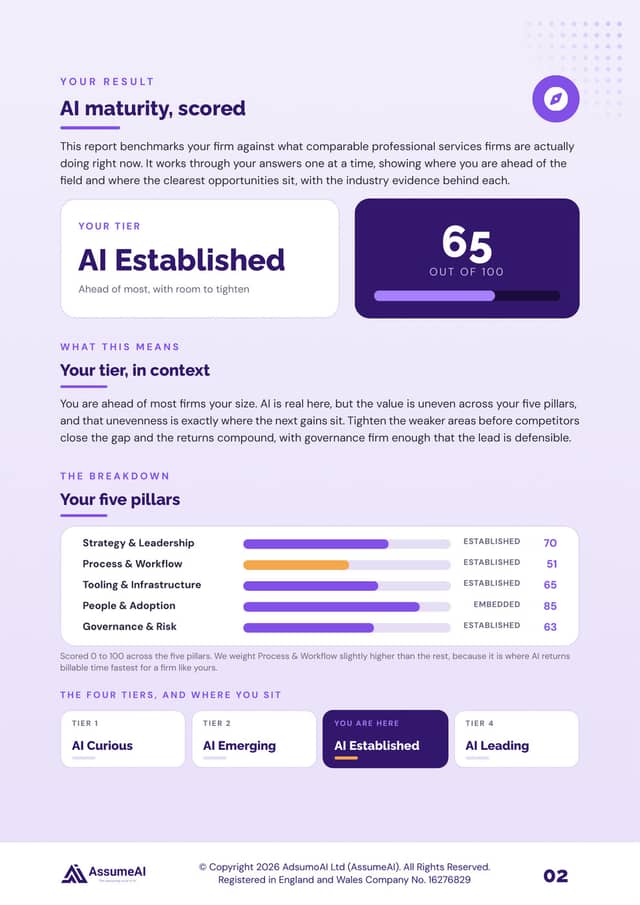
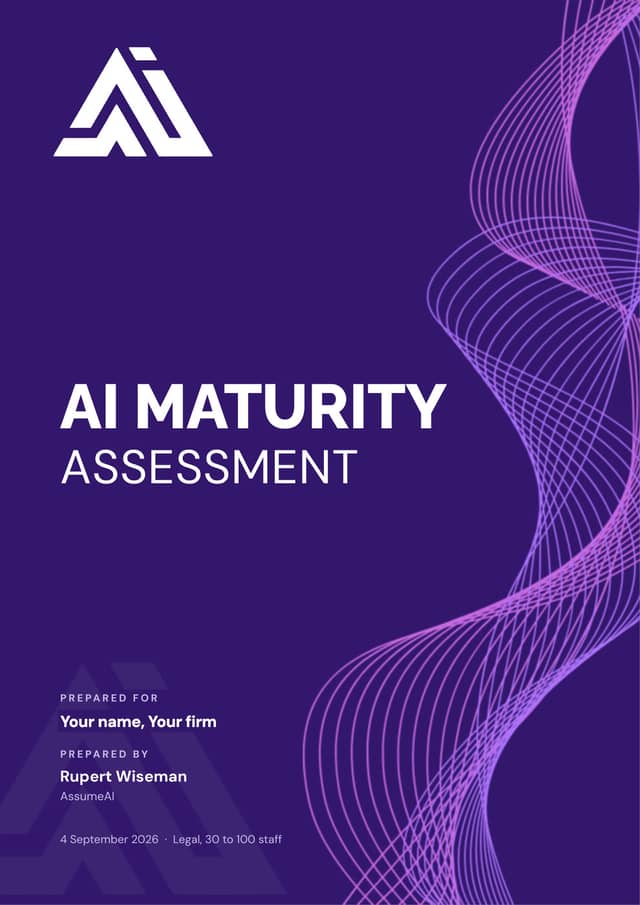
If you would like a benchmark before any of it, the free AI maturity assessment is nine questions and about two minutes, built for professional services firms of 20 to 200 staff, with your scored report in your inbox immediately.
- AI implementation roadmap
- AI risk assessment
- AI readiness assessment
- AI audit report

The Litmus Partnership
“AssumeAI are a pleasure to work with and delivered a clear, concise and practical AI strategy review. Within a short timespan, they demonstrated a deep understanding of our business and articulated a prioritised roadmap which we can now execute, with sensible governance, training and risk controls built in.
We look forward to continuing to work with Hugh and Rupert to drive differentiation and efficiencies throughout our consultancy with AI and automation.”
Stage two: why does governance come before the build?
Because a firm that answers to clients, auditors and a chartered or professional body cannot let its people paste client material into whichever tool they found last week, and a blanket ban does not work either; it just pushes usage underground. Clear guardrails, in place before anything is deployed, let people use AI safely and consistently, and they set the rules every later build has to respect.
AI governance implementation runs in four steps and typically takes two to four weeks:
- Understand your obligations: your data, your clients and the bodies you answer to, because no two firms are the same.
- Draft the framework: internal AI policies for your teams, external AI policies for clients and partners, and impact assessments that fit how you work.
- Put controls in place: audit trails, a risk register and an incident log.
- Align and maintain: compliance with GDPR, SOC and your professional bodies, with a simple review cadence.
For Hillbreak, a specialist ESG and sustainability advisory firm, this meant assessing its existing AI policy against the RICS professional standard on the responsible use of AI in surveying practice. We identified twelve new provisions and prepared a nine-document pack, taking the policy from four rules to thirteen. If you do not have a policy yet, the governance template we use with clients is free on our resources page.
Describe the defined business use case for this tool. What problem does it solve, and what outputs will it produce?
| Non-AI alternatives considered | |
|---|---|
| Why AI is more appropriate than alternatives | |
| Is this use of AI proportionate to the task? |
 Governance pack · Template
AI Tool Impact Assessment
Complete one per AI tool. Retain as a governance record.
| Tool name | |
|---|---|
| Vendor or provider | |
| Version or model | |
| Date of assessment | |
| Assessor | |
| Business owner | |
| Date of first use | |
| Next review date |
- Built inside your infrastructure
- You own all of it, code included
- EU-based data hosting
- GDPR, SOC and professional bodies
Stage three: how do we build AI that works in a real firm?
Only once the priorities are ranked and the safeguards are in place do we design and build. We build production-grade AI that works in real environments, and we build it inside your business rather than on top of it: everything lives in your existing infrastructure and you own all of it, code included. We build around your processes rather than around one model, so you can change what sits underneath as the tools improve.
The build takes one of four shapes, depending on what the first stage found:
- A 30-day implementation sprint: one week to agree what to build, three weeks to roll it out, for one clear workflow.
- A 90-day implementation sprint: two weeks to identify and prioritise, eight weeks to develop and deploy, two weeks to embed, for several workflows.
- Enterprise AI Deployment: Claude Cowork or ChatGPT Enterprise on EU-based data hosting, configured to your data governance policies, with six to twelve agents and skills built around your real workflows.
- The managed service: half an engineer, or one or two, embedded in your firm on a monthly footing.
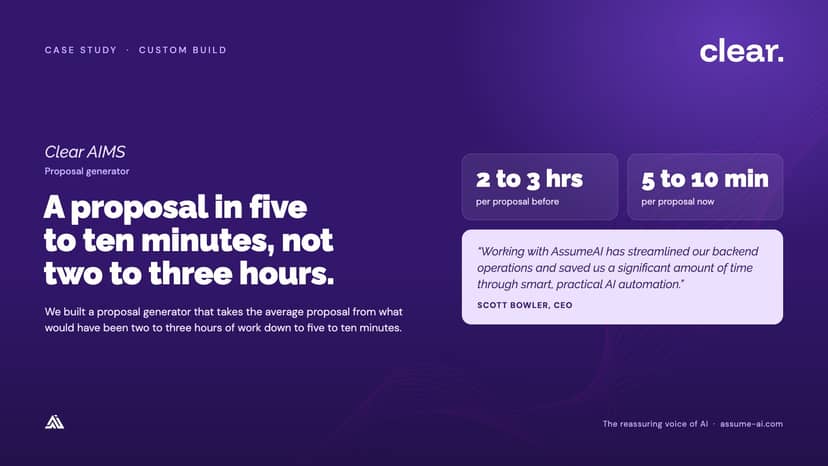
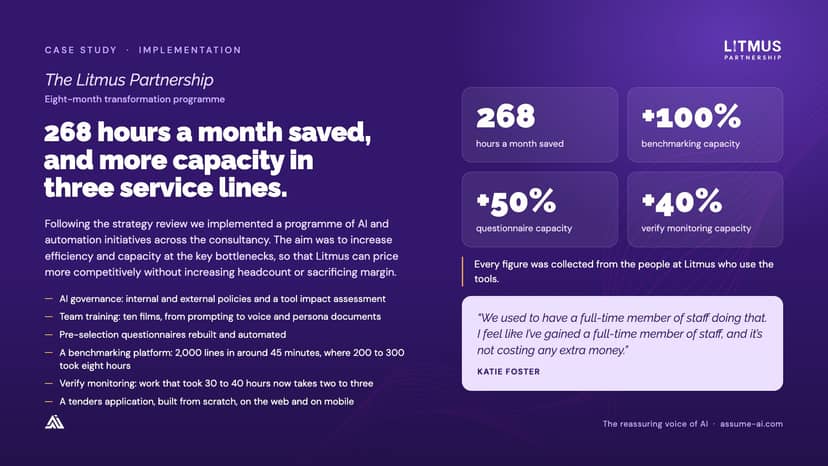
Whatever the shape, the people who will use the system test it with us before it goes live. In a consultancy they are also the people who know whether its output is good enough to put in front of a client, so we design with them, not around them. The results are on our work page: a proposal generator for Clear AIMS that takes the average proposal from two to three hours to five to ten minutes, and a benchmarking platform for The Litmus Partnership that handles 2,000 lines in around 45 minutes where 200 to 300 lines used to take eight hours.
Stage four: how do we embed the work and hand it over?
The aim of every engagement is a firm that no longer needs us for the work we did. A 30-day sprint ends with us deploying, handing over and showing your team how to run it, then recommending the highest-value thing to do next. The 90-day sprint spends its last two weeks embedding the capability in your team. Enterprise deployments come with documentation of every agent and skill, so your team can maintain and extend them.
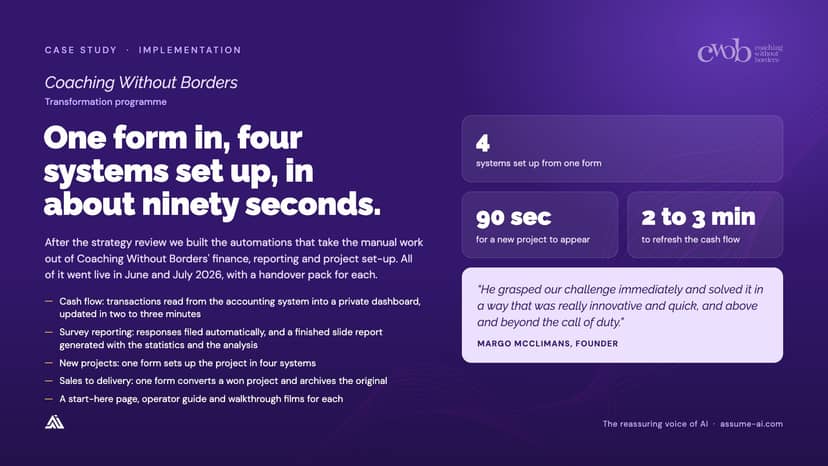
At Coaching Without Borders the automations went live in June and July 2026, each with its own handover pack: a start-here page, an operator guide and walkthrough films for each automation. Governance is handed over the same way. Hillbreak's impact assessment workshop completed a worked example of all nine sections of the template together, with every risk rated before and after mitigation, so the team can carry out assessments themselves.
Training belongs to this stage too. Tailored AI team training covers Claude, Cowork, Gemini and Prompt Engineering Fundamentals, built around your real work rather than generic demos. For firms that want capability to grow inside the business rather than arrive in a report, the managed service puts one of our engineers side by side with your people, transferring capability as the work happens. Benj Johns, CFO of Sladen Consulting, described working with us as “a partnership process, rather than a supplier and client process”.
- A start-here page and an operator guide
- Walkthrough films for each automation
- Documentation of every agent and skill
- Governance your team can run itself
- The code, which you own
What holds across every engagement?
Six rules apply whichever stage you start at and whichever service you buy.
- Nothing is built without justification. Every build traces back to a ranked, costed opportunity.
- Nothing is deployed without safeguards. Policies, controls and training come first.
- You sign off exactly what gets built, with the number and the return it is based on in front of you.
- We build inside your infrastructure, and you own all of it, code included.
- The work is founder-led from end to end. Rupert Wiseman and Hugh Dowling are accountable for it, with an associate network of over ten AI consultants and AI engineers behind them, so the work is never waiting on one person.
- Every service carries a guarantee. If a 30-day sprint is not live and delivering value in 30 days, for example, we keep working at no extra cost until it is.
We are not the cheapest option, and if you want a quick hack we are the wrong firm. Every service, with its price, timeline and guarantee, is listed with the company details on AssumeAI at a glance.
Which service covers which stage?
Every service maps onto the method. Most firms start at stage one; if you already know the bottleneck you want gone, a sprint folds a compact version of stage one into its first week. Every price is published.
| Service | Investment |
|---|---|
| AI Priorities WorkshopTwo pain point workshops and a concise roadmapStage 1 | From £4,000 |
| AI Strategy ReviewSurveys, interviews, a tech stack review and five documentsStage 1 | From £12,000 |
| AI Governance ImplementationPolicies, impact assessments and audit trailsStage 2 | From £3,000 |
| 30-Day Implementation SprintOne use case, built and deployedStages 1, 3 and 4, for one workflow | From £6,000 |
| 90-Day Implementation SprintSeveral workflows built, deployed and embeddedStages 1, 3 and 4 | From £15,000 |
| Enterprise AI DeploymentClaude Cowork or ChatGPT Enterprise, with six to twelve agents and skillsStages 2, 3 and 4 | £20,000 ex VAT |
| Tailored AI Team TrainingWorkshops across Claude, Cowork, Gemini and moreStages 2 and 4 | From £5,000 |
| Managed ServiceHalf, one or two engineers embedded in your firmStages 3 and 4 | From £5,500 per month |
If you work in a consulting firm, our page on AI for consultancies shows where the method has paid back first. If your firm answers to a chartered or professional body, AI for professional services goes further into the governance stage.
How long does each stage take?
Stage one takes about six weeks as a full AI Strategy Review, depending on the size of the business; focused reviews have run faster, two weeks for Litmus, three for Hillbreak and four for Coaching Without Borders. Stage two, governance, takes two to four weeks. Stage three ranges from a 30-day sprint, which puts one working solution live within a month, to a 90-day sprint that builds several. Stage four is built into the end of each build rather than bolted on afterwards.
Larger programmes are sequenced rather than rushed. The Litmus programme ran over eight months, covering AI policies and a tool impact assessment, ten training films, rebuilt questionnaires, the benchmarking platform and a tenders application, and the firm now saves 268 hours a month. Much of the real work is agreeing what to build, which is why every engagement starts there.
- AI governance implementation2 to 4 weeks
Policies and controls · Up to four weeks
- AI Strategy ReviewAbout six weeks; focused reviews in two to four
Surveys, interviews, tech stack
- 30-day implementation sprintAbout four weeks
Agree · Roll it out
- 90-day implementation sprintAbout twelve weeks
Prioritise · Develop and deploy · Embed
- A full programmeSequenced, not rushed
Eight months at The Litmus Partnership
Questions
Do we have to go through all four stages with you?
No. You can take all four stages with us, or take one and run the rest yourself. The plan is yours whoever does the building: the roadmap, the risk assessment and the other documents belong to you either way. If you already know the bottleneck you want gone, a 30-day sprint folds the first stage into its first week.
Why does governance come before the build?
Because nothing should be deployed without safeguards. A blanket ban does not work; it just pushes usage underground. Clear policies, controls and training, in place before anything goes live, let your people use AI safely and consistently, and they set the rules the build has to respect on client data, access and audit trails.
How do you decide what to build first?
We find where your hours go and put a cost against each opportunity, ranked. The roadmap is sequenced highest value first, and you sign off exactly what gets built, with the number and the return it is based on in front of you. We will not quote a build before we know where your hours go.
How long does the whole method take?
It depends on where you start. Governance work takes two to four weeks. The AI Strategy Review takes about six weeks, and focused reviews have run in two to four. A 30-day sprint puts one working solution live within a month, and a 90-day sprint builds and embeds several. Larger programmes are sequenced over months, as the eight-month programme at The Litmus Partnership was.
What do we own at the end?
All of it, code included. We build inside your existing infrastructure rather than on top of it, and every build ends with a handover: documentation, operator guides or walkthrough films, and a roadmap you can run without us. You are never locked in.