
AI training for staff that actually sticks.
Good AI training for staff teaches people to use the AI tools your firm has approved, on their own real work and within your data rules, and then checks that they keep doing it. In the UK the basics are now free, through the government's AI Skills Hub; the step that changes how a firm works is training built around its own tasks, documents and tools. This guide covers the formats, what to include, how to measure it and what it costs.
- Claude Cowork workshops for Hillbreak
- 3
- Custom skills built for its own work
- 6
- Training films in the Litmus programme
- 10
- Worked use cases, brief to finished document
- 2
Firms we have built with
















Why does AI training for staff matter now?
Buying an AI tool is the easy part. Getting a whole team to use it well is not. In many professional firms the pattern is the same: a few keen people use AI every day, most of the team does not, the licences mostly sit unused, and what the keen people know lives in one or two heads and never spreads. Generic online courses rarely fix that, because they do not map to how a particular firm works.
The government has made the basics free. Every adult in the UK can take free courses on its AI Skills Hub, a selection of them industry-developed and checked against Skills England's AI foundation skills for work benchmark, some taking under 20 minutes, as part of a joint government and industry programme to give 10 million workers AI skills by 2030. That is a useful floor. It does not teach your people to use the tools your firm has approved, on your clients' work, under your rules, which is where both the value and the risk sit.
There is a compliance reason too. Article 4 of the EU AI Act, which has applied since 2 February 2025, asks providers and deployers of AI systems to take measures to support the AI literacy of the staff who use them. An amendment in 2026 softened the wording, so firms no longer have to guarantee a set level, but the duty to take measures remains, and it matters to UK firms that provide or use AI systems in the EU. In the UK, data protection law applies whenever someone puts personal data into an AI tool, and the ICO's guidance covers AI systems bought from a supplier as well as those a firm builds itself, so buying a tool does not hand your responsibilities to the vendor. Professional bodies are adding their own rules: the RICS standard on the responsible use of AI in surveying practice took effect on 9 March 2026.
- Licences that mostly sit unused
- A few keen people, and everyone else waiting
- Client data going into tools nobody approved
- Generic courses that miss how your firm works
What formats does AI training for staff come in?
There are four broad formats, and most firms end up using more than one. The right mix depends on how far apart the most and least confident people in the team are, and on whether you want a quick lift or a lasting change.
Free online courses
Self-paced courses, including the free ones on the government's AI Skills Hub and the tool makers' own material. Good for vocabulary and confidence, and for getting everyone to the same starting line. Weak on your tools, your rules and your work, so treat them as a foundation rather than the whole answer.
Live workshops
A session, remote or on site, run by someone who has prepared around your team's real tasks. This is the fastest way to lift a whole team at once, because people practise on work they recognise and can ask about the cases that worry them. One workshop built on your own documents does more than several generic ones.
Training alongside a rollout
Workshops timed with a pilot or a new tool, so people learn on the platform they are about to use and leave with things already built for them: skills, projects, templates and a cheat sheet. This is how we ran Hillbreak's Claude Cowork training.
A sustained programme
A sequence of sessions and self-serve material over months, so fluency spreads beyond the early adopters. Films, guides and short exercises let new joiners catch up without another workshop. We deliver these on our own custom learning platform.
What should good AI training for staff cover?
The best test of a syllabus is whether people can do something on Monday that they could not do on Friday. That takes six things, and generic courses usually cover only the first.
- How the tools work and where they fail: enough to know why an answer can be fluent and wrong at the same time.
- Your firm's rules: which tools are approved, what data can and cannot go into them, and what has to be checked before anything reaches a client. If you do not have a policy yet, write it before you train, or the training has nothing to point to.
- Prompting on real work: briefs, context and examples, practised on the firm's own documents rather than toy demonstrations.
- Checking the output: verifying facts, figures and sources, and knowing which tasks always need a second pair of eyes.
- Your voice: a voice and persona document, so drafts sound like the firm rather than like a chatbot. Our free training film on building one is on our resources page.
- Reusable building blocks: saved skills, projects and templates, so good practice is captured once and used by everyone, not rebuilt by each person.
The last point is the one most often missed. Training that leaves nothing behind tends to fade once the session is over. Training that leaves working skills, projects and a one-page cheat sheet keeps paying back, because the next person to join the team inherits it.
- How the tools work, and fail
- Your firm's rules
- Prompting on real work
- Checking the output
- Your house voice
- Reusable skills and projects
What does AI training look like in a real firm?
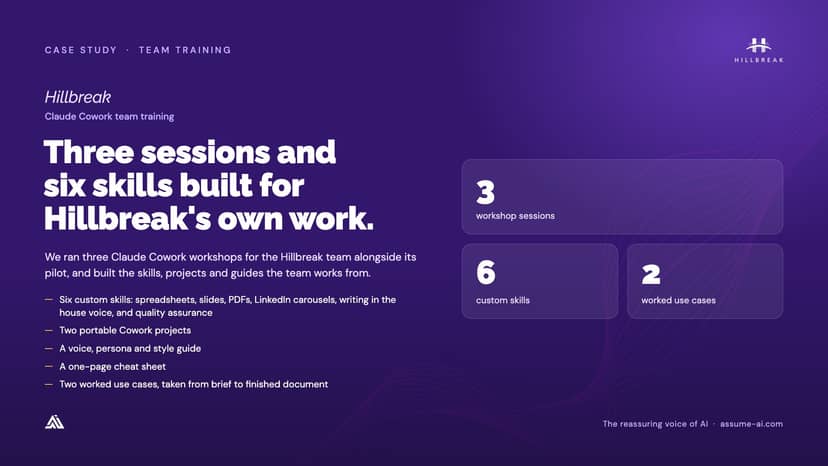
Hillbreak is a specialist ESG and sustainability advisory firm for the real estate sector. We ran three Claude Cowork workshops for its team alongside its pilot, and built what the team works from: six custom skills covering spreadsheets, slides, PDFs, LinkedIn carousels, writing in the house voice and quality assurance; two portable Cowork projects; a voice, persona and style guide; a one-page cheat sheet; and two worked use cases taken from brief to finished document.
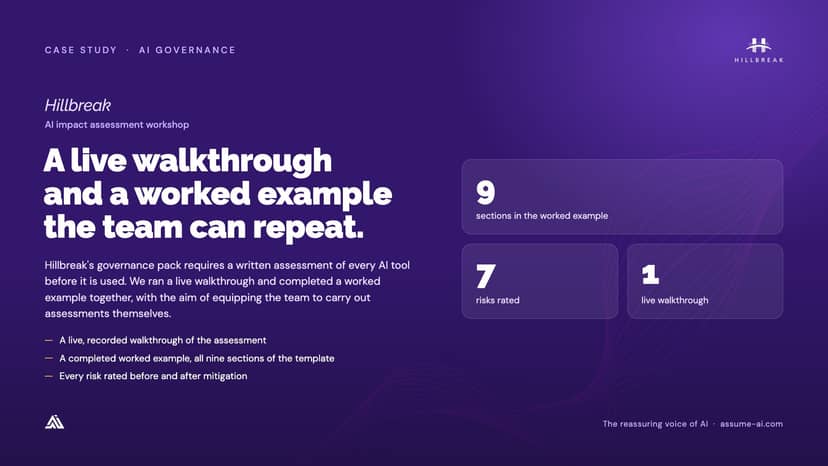
Training on governance works the same way. Hillbreak's governance pack requires a written assessment of every AI tool before it is used, so rather than hand over a template we ran a live walkthrough and completed a worked example together, all nine sections, with every risk rated before and after mitigation. The aim was a team that can carry out assessments itself.
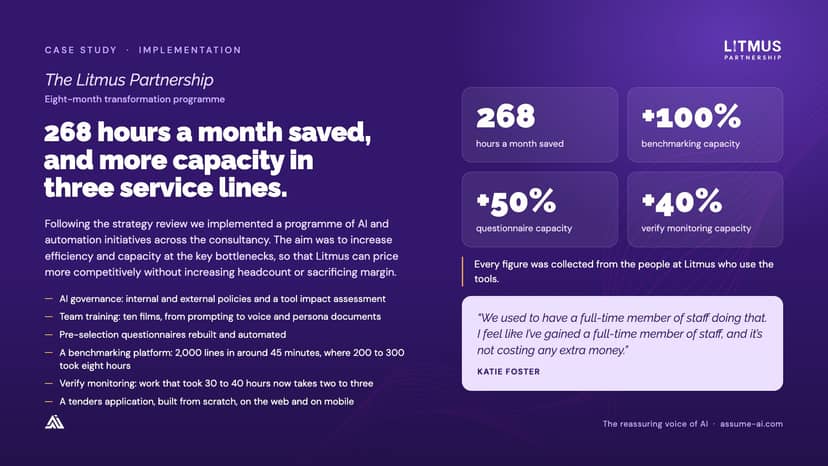
At The Litmus Partnership, training was one strand of an eight-month programme, delivered as ten films that run from prompting to voice and persona documents, so people can go back to them when they need them. The programme as a whole now saves the firm 268 hours a month, and every figure was collected from the people at Litmus who use the tools. Training was not the whole of that, but tools nobody uses save nothing.
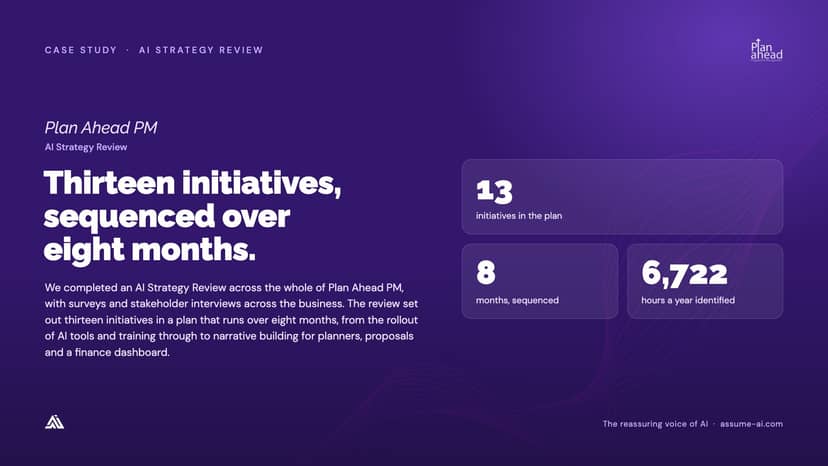
Where a firm starts with a strategy review, training usually appears early in the plan. The review for Plan Ahead PM set out thirteen initiatives over eight months, running from the rollout of AI tools and training through to narrative building for planners, proposals and a finance dashboard.
How do you measure whether AI training for staff worked?
Most AI training is judged by a feedback form on the day, which tells you whether people enjoyed it and very little else. The Kirkpatrick model, a framework for evaluating training that Donald Kirkpatrick set out in the 1950s, has four levels, and each one translates simply to AI. Set the baseline before the first session, or there will be nothing to compare against.
Reaction: was it relevant?
Ask on the day, but ask about relevance and confidence rather than enjoyment. The useful question is whether each person will use what they learned on a live piece of work this week, and if not, what is stopping them.
Learning: can they do it?
Give everyone one real task at the end of the session, such as a first draft, a summary of a long document or a check of a spreadsheet, and look at the output rather than the attendance list. If the output is not good enough to use, the session has not done its job yet.
Behaviour: are they still doing it?
Look again at 30 and 90 days. Who is using the approved tools, and how often? Which tasks have moved to AI, according to the managers who see the work? Usage that falls back to the same few people means the training has not spread.
Results: what changed for the firm?
Pick two or three tasks before you train, time them, and time them again afterwards. Count the hours with the people who do the work, as Litmus did, rather than estimating them from the top. That is the number a partner or a board will believe.
How much does AI training for staff cost in the UK?
There are three ways to pay for it, and the differences in price mostly reflect how much of the training is built around your firm.
- Free: the government's AI Skills Hub courses and the tool makers' own material. No fee, but they cost staff time, and they stop at the basics.
- A tailored workshop or a short series: what you are paying for is the preparation, someone learning your tools, your rules and your work so that the session runs on them.
- A sustained programme: a sequence of sessions plus self-serve material over months. It costs more up front, but new joiners use the same material without another session.
Our Tailored AI Team Training starts from £5,000, for one-off workshops or a sustained programme. If your team does not leave able to apply AI to their real work, we run the session again at no cost.
Two costs are easy to miss. The first is the licences you already pay for and do not use; training is often the cheapest way to get value from money already spent. The second is the policy. If staff are to be trained on what they may and may not do, the rules have to exist first. Our AI governance implementation starts from £3,000, and the governance template we use with clients is free on our resources page.
How do you choose an AI training provider for your staff?
Whoever you use, five questions separate training that changes how a firm works from training that fills an afternoon.
- Will they train on the tools we have approved, and on our own documents?
- Will they cover our data rules and the requirements of our professional body?
- What will we have afterwards: skills, projects, templates, a cheat sheet, recordings?
- How will we know it worked, at 30 and 90 days, not just on the day?
- What happens if the team cannot apply it?
Our own answer to those questions is our Tailored AI Team Training service. We learn your level, your tools and the work your team does; build each session around that real work; run hands-on workshops across Claude, Cowork, Gemini, Prompt Engineering Fundamentals and almost any AI topic you need, remotely or on site; and, where the need is deeper, sustain it with a tailored programme on our own platform. The service page has the detail and the price. This guide is here so that you can judge any provider, including us.
AssumeAI is a UK, founder-led AI consultancy run by Rupert Wiseman and Hugh Dowling, working with consultancies and professional services firms. Training is rarely the only thing a firm needs. If you are not sure where AI should start, the free AI maturity assessment benchmarks your firm in about two minutes, and our guides to AI for consultancies and AI for professional services cover the rest of the picture.


Where do the facts in this guide come from?
The figures about AssumeAI's own work come from our published case studies, linked above. The external facts were checked on 21 October 2026 against these sources.
- GOV.UK, 28 January 2026: Free AI training for all, as government and industry programme expands to provide 10 million workers with key AI skills by 2030
- EU AI Act, Article 4: AI literacy
- Information Commissioner's Office: Guidance on AI and data protection
- RICS: Responsible use of artificial intelligence in surveying practice
- Kirkpatrick Partners: The Kirkpatrick Model
Questions
Do we have to give staff AI training?
If your firm provides or uses AI systems in the EU, Article 4 of the EU AI Act asks you to take measures to support the AI literacy of the staff who use them. It has applied since 2 February 2025, and an amendment in 2026 made clear that no set level has to be guaranteed. In the UK, data protection law applies whenever someone puts personal data into an AI tool, and professional bodies are adding their own rules: the RICS professional standard on the responsible use of AI in surveying practice took effect on 9 March 2026. Even where nothing obliges you, training is one of the cheapest controls a firm has.
How long does AI training for staff take?
It depends on the format. Some of the free courses on the government's AI Skills Hub take under 20 minutes. A live workshop is a single session. Hillbreak's Claude Cowork training was three workshops run alongside its pilot, and a sustained programme runs over months, so that fluency spreads beyond the early adopters.
Should AI training be online or in person?
Either works. We run sessions remotely or on site, whatever suits your team. What matters more than the room is that people practise on their own work during the session, with the tools they will actually use afterwards.
Which AI tools should staff be trained on?
The ones your firm has approved and pays for, because that is where your data protections sit. We run workshops across Claude, Claude Cowork and Gemini, and Prompt Engineering Fundamentals carries across tools. If your firm is still choosing a platform, settle that first, so that people learn on the tool they will keep.
How much does AssumeAI's team training cost?
Tailored AI Team Training starts from £5,000, for one-off workshops or a sustained programme on our own platform. If your team does not leave able to apply AI to their real work, we run the session again at no cost.