
AI proposal writing for consultancies.
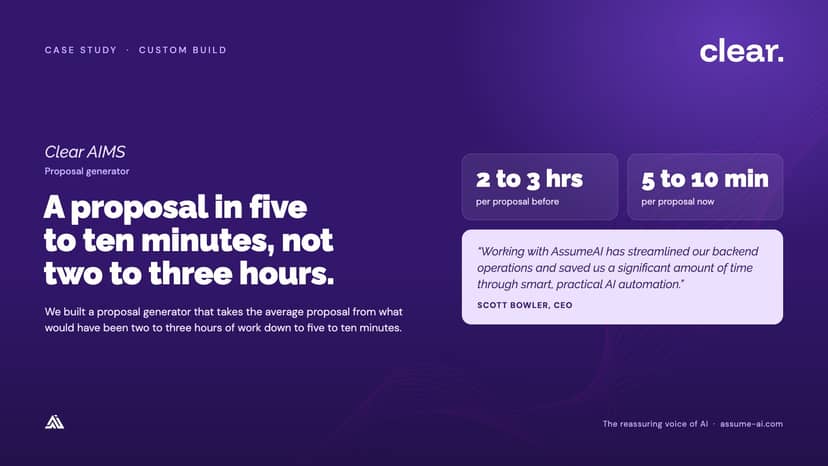
AI proposal writing means letting an AI model assemble the first draft of a proposal from your own past proposals, approved boilerplate and the notes from the client conversation, so your consultants spend their time on judgement and price rather than assembly. Done well it is fast: the proposal generator we built for Clear AIMS takes the average proposal from two to three hours of work down to five to ten minutes. Done carelessly it leaks client information and puts invented claims in front of a buyer, so the workflow below puts the controls first.
- At most, for a Clear AIMS proposal that took two to three hours
- 10 min
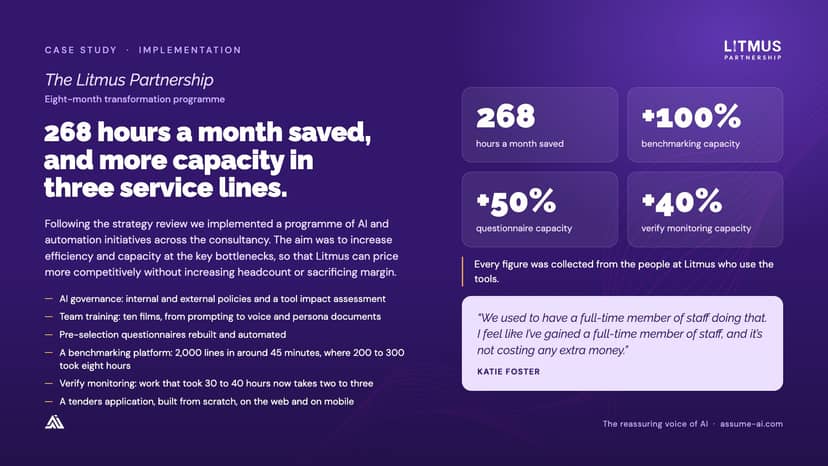
- Questionnaire capacity at The Litmus Partnership
- +50%
- Hours a month now saved at Litmus
- 268
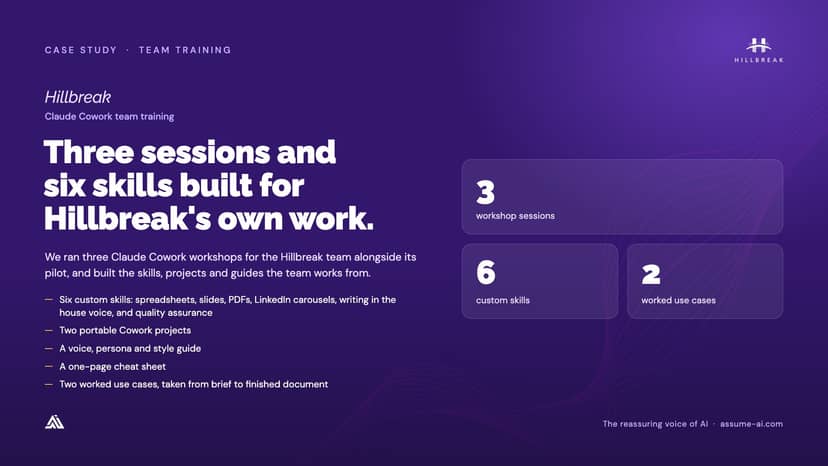
- Custom skills for Hillbreak, including house voice and QA
- 6
Firms we have built with















How can a consultancy use AI to write proposals faster?
Most of the hours in a consultancy proposal do not go on the thinking. They go on finding the last proposal that looked like this one, copying the right case studies and team biographies across, rewriting the methodology so it reads as if it was written for this client, and fixing the formatting. That assembly work is exactly what a large language model does well, provided it is working from your material and not from the open internet.
The workflow that holds up in practice has five parts:
- A proposal library: your best past proposals, approved case study wording, team biographies and standard terms, cleaned and labelled.
- A structured brief from the client conversation, in the client's own words, with the decision criteria and budget signals.
- A template that fixes the sections, the house voice and the places where only a person may write, such as scope and price.
- A model on a business account that drafts from the library and the brief, and marks a placeholder wherever it has no source.
- A quality check by the consultant who will sign the proposal, against a short written checklist, before anything leaves the firm.
The rest of this guide takes each part in turn, with the risks that come with it. If you want the wider picture of where AI pays back in a consulting firm, our page on AI for consultancies covers it.
How do you reuse past proposals without copying old mistakes?
An AI proposal tool is only as good as the material it draws on. Point it at a shared drive of every proposal the firm has ever sent and it will happily reuse a superseded price, a team member who left two years ago, or a paragraph written for a competitor of the client in front of you.
The fix is a small, curated library rather than a large, messy one. Four things matter most:
Winning proposals, cleaned
Choose the proposals you would be happy to send again, usually the ones that won, and remove anything specific to the original client: names, figures, dates and confidential detail. Label each by service line, sector and size of engagement, so the model can find the closest match rather than the most recent.
Approved boilerplate
Keep the case study wording, team biographies, methodology descriptions and standard terms in one place, in the form the firm has approved. Case studies in particular should be ones the client has agreed you can use, worded as they agreed it.
One source for every figure
Every number that can appear in a proposal, from day rates to results achieved for past clients, should come from one maintained source. When the model needs a figure it quotes that source; when it cannot find one it leaves a gap for a person to fill.
An owner and a review date
Someone has to own the library, retire what is out of date and add each new winning proposal. Without an owner, the library drifts back into the shared drive it replaced.
What does a safe AI proposal workflow look like, step by step?
Each step below has a clear owner. The model does the assembly; a person makes every decision that a client could hold you to.
1. Capture the brief
Record or note the client conversation and turn it into a structured brief: the problem in the client's own words, what success looks like to them, who decides, the timeline and any budget signal. A model is good at producing this summary from a transcript, and a consultant should correct it before it is used.
2. Decide whether to bid
Whether a proposal is worth writing is a commercial judgement about fit, relationship and capacity. AI can summarise the evidence, but a partner or director makes the call. Writing faster is no help if you are writing proposals you should not.
3. Retrieve what fits
The model searches the library for the closest past proposals, case studies and biographies for this sector and service line, and shows which sources it chose so the consultant can swap any that do not fit.
4. Draft in the house voice
The model drafts each section from the brief and the retrieved material, following the template and a written voice and style guide. Wherever it has no source for a claim, it leaves a visible placeholder rather than a plausible guess.
5. Scope and price by hand
The scope, the deliverables, the timeline and the fee are written or confirmed by the consultant who will lead the work. These are the parts a client will hold you to, and they depend on judgement the model does not have.
6. Check, then learn
The signing consultant reads the whole draft against the checklist under quality control below. Afterwards, record whether the proposal won and why, and add winners to the library, so the next draft starts from better material.
Is it safe to put client information into an AI proposal tool?
A proposal often contains the most sensitive things a prospective client has told you: their problems, their numbers and sometimes their people. Where that text is processed matters.
Use a business account, not a personal one. OpenAI states that it does not use data from ChatGPT Enterprise, ChatGPT Business or its API to train its models by default. In 2025 Anthropic changed its consumer terms so that chats on Claude's free and paid personal plans can be used to train its models when the user's training setting is on, and said the change did not apply to Claude for Work or to its API. A consultant pasting a client brief into a personal account is therefore a different risk from the same consultant using the firm's business platform.
Personal data in a proposal, such as names, roles and anything about individuals, falls under UK data protection law. The Information Commissioner's Office publishes guidance on AI and data protection, and the principles are familiar: use only what you need, know where it goes, and be able to explain it.
Put this into a short written policy before the tool goes live: which platforms are approved, what may and may not be entered, and who checks new tools. When we prepared Hillbreak's governance pack, it included an approved tools register, an AI tool impact assessment template and boilerplate AI clauses for client engagements and reports. Our AI governance implementation service covers the same ground for other firms.
- Client material in personal or free AI accounts
- One client's confidential detail in another's proposal
- Tools no one has assessed or approved
- Contracts and NDAs that limit where data may go
How do you check an AI-drafted proposal before it goes out?
The danger with an AI draft is not that it reads badly. It is that it reads well and is wrong. Language models produce fluent text whether or not they have a source, and a proposal that cites a result you never achieved is worse than a slow proposal.
Two recent cases show what happens when nobody checks. In 2025 Deloitte Australia agreed to repay part of its fee for an A$440,000 report to an Australian government department, after a researcher found fabricated references and a fabricated quote from a court judgment; the revised report disclosed that a generative AI tool had been used. In June 2025 the High Court in London, in Ayinde v London Borough of Haringey, warned lawyers that citing fictitious authorities could lead to regulatory referral, and said that those who lead firms must take practical steps to prevent it. A proposal is a lower-stakes document than a court filing, but it is a promise to a client, signed in your firm's name.
A checklist the signing consultant works through before anything is sent:
- Every figure traces to the firm's maintained source, and every past result is one the client has agreed you may quote.
- Every case study, client name and logo is approved for use, and no other client's confidential detail has crept in from the library.
- The client's name, people, problem and dates are right throughout, including in headers and file names.
- The scope, deliverables, timeline and fee were set by a person and agree with each other.
- No placeholder is left unfilled, and no claim survives that the consultant could not defend in a meeting.
- The voice is the firm's: read aloud, it should sound like the person who will deliver the work.
Some of this can be automated too. For Hillbreak we built six custom Claude Cowork skills, among them one for writing in the house voice and one for quality assurance, alongside a voice, persona and style guide. Automated checks catch the mechanical errors; the person signing the proposal still owns the judgement.
Can you use AI to write tenders and public sector bids?
Yes, with care. UK central government guidance, Procurement Policy Note 017, says there are potential benefits to suppliers using AI to develop their bids and that suppliers' use of AI is not prohibited. It also tells contracting authorities they may ask suppliers to disclose their use of AI in creating a tender, may carry out additional due diligence such as clarification questions or supplier presentations, and should put controls in place so that suppliers do not use the authority's confidential information. The note applies to central government departments, their executive agencies and non-departmental public bodies; other public bodies may choose to follow it.
In practice that means two things. Write every bid as if you will be asked how it was produced, and as if a member of the delivery team will have to defend every claim in a presentation. And never put the buyer's own non-public tender documents into a tool that might train on them.
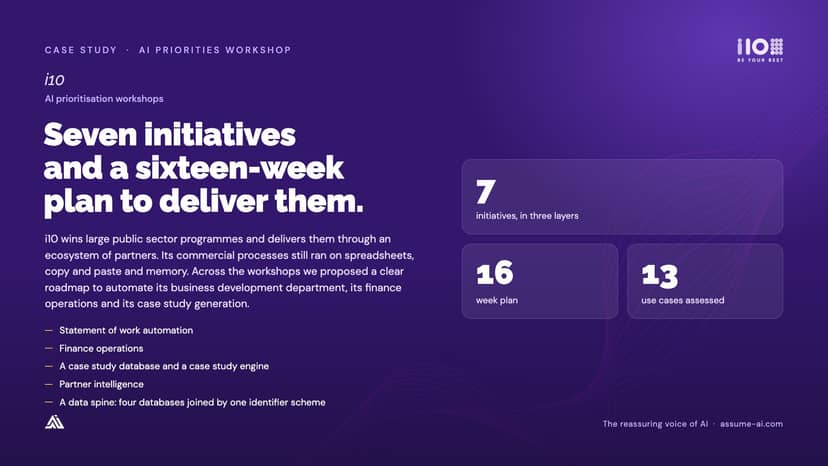
Tender and questionnaire work is also where the volume is. At The Litmus Partnership the pre-selection questionnaires were rebuilt and automated, and questionnaire capacity is up 50%; we also built a tenders application from scratch for the web and for mobile. For i10, which wins large public sector programmes, the roadmap from our workshops included statement of work automation and a case study database and case study engine.
What did an AI proposal generator achieve at Clear AIMS?
Clear AIMS asked us for a proposal generator. It takes the average proposal from what would have been two to three hours of work down to five to ten minutes. Scott Bowler, its CEO, said: “Working with AssumeAI has streamlined our backend operations and saved us a significant amount of time through smart, practical AI automation.”
Proposals also feature in wider AI plans. The AI strategy review for Plan Ahead PM set out thirteen initiatives over eight months, running from the rollout of AI tools and training to narrative building for planners, proposals and a finance dashboard.
Should you buy an AI proposal tool or build your own?
There are three sensible routes, and the right one depends on how many proposals you write and how different they are.
- A general business AI platform, set up well. Claude Cowork or ChatGPT Enterprise, with a proposal skill that drafts from your templates and library, suits most small and mid-sized consultancies. Our enterprise AI deployment puts one in place with six to twelve agents and skills, at £20,000 ex VAT.
- A dedicated bid or proposal product. Worth considering if you answer a high volume of formal tenders and questionnaires; judge it on where your data goes and how easily it uses your own library.
- A custom generator, built around your process. The right choice when proposals follow a pattern specific to your firm, as at Clear AIMS. A 30-day implementation sprint, from £6,000, builds and deploys one use case.
Whichever you choose, the people using it need to know how to brief it and how to check it. Our tailored AI team training starts from £5,000. If you would like to know where your firm stands first, the free AI maturity assessment takes about two minutes. For firms in regulated professions, our page on AI for professional services covers the governance in more depth.
Sources
External facts on this page come from the following. AssumeAI results are from our published case studies.
- PPN 017: Improving transparency of AI use in procurement, Cabinet Office, February 2025.
- Guidance on AI and data protection, Information Commissioner's Office.
- Business data privacy, security and compliance, OpenAI.
- Updates to our consumer terms, Anthropic, August 2025.
- Ayinde v London Borough of Haringey and Al-Haroun v Qatar National Bank, judgment of the Divisional Court, 6 June 2025.
- Deloitte refunds Australian government after AI errors in report, CFO Dive, October 2025.
Questions
How can a consultancy use AI to write proposals faster?
Give an AI model on a business account three things: your best past proposals and approved boilerplate, a structured brief from the client conversation, and a template that sets the sections and the house voice. Let it assemble the first draft, which is where most of the hours in a proposal go and the part AI handles well, then have a consultant own the scope, the price and the final read. The proposal generator we built for Clear AIMS takes the average proposal from two to three hours of work down to five to ten minutes.
Can ChatGPT or Claude write a whole proposal on its own?
It can produce something that looks like a whole proposal, which is the risk. A model with no access to your past work will fill gaps with plausible inventions: case studies you never delivered, figures nobody measured, a methodology you do not use. Used well, it drafts from your own material and leaves a visible placeholder wherever it has no source, and a person decides the scope, the price and every claim.
Is it safe to put client information into an AI tool?
Only on an account whose terms say your data is not used to train models, and within your own AI policy. OpenAI says it does not train on data from ChatGPT Enterprise, Business or its API by default, and Anthropic's 2025 change to its consumer terms did not apply to Claude for Work or its API. Personal and free accounts are a different matter. Check your client contracts and NDAs too, because some restrict where their information may be processed.
Do we have to tell a client that AI helped write the proposal?
There is no general rule that you must, but some buyers will ask. UK central government guidance (PPN 017) says suppliers' use of AI to write bids is not prohibited, and that contracting authorities may ask suppliers to disclose it and may test bids through clarification questions and presentations. The safe position is to write every proposal so that you would be comfortable disclosing how it was made and defending every claim in it.
How long does it take to set up an AI proposal workflow?
If your past proposals and boilerplate are in reasonable order, a working version can be built and rolled out in a 30-day implementation sprint: one week to agree exactly what to build, three weeks to roll it out. Most of the effort goes into the proposal library and the checks, not the model.