
AI for HR consultancies: what works, and what to avoid.
AI for HR consultancies means using AI to take the drafting, research and admin out of HR advisory work, so consultants spend their time on judgement and clients, while employee data and legal accuracy stay under control. AssumeAI is a UK, founder-led AI consultancy and AI engineering firm that puts the governance in place first and then builds. This guide covers where AI helps an HR consultancy, where it does not, and how to start.
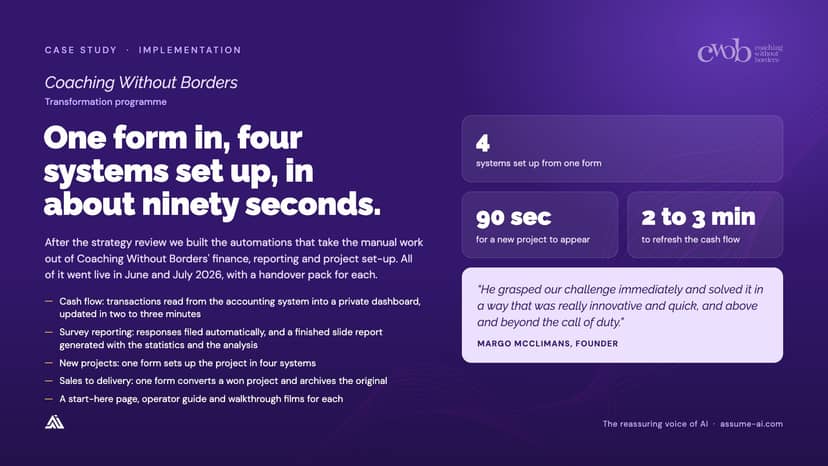
- To set up a new project in four systems
- 90 sec
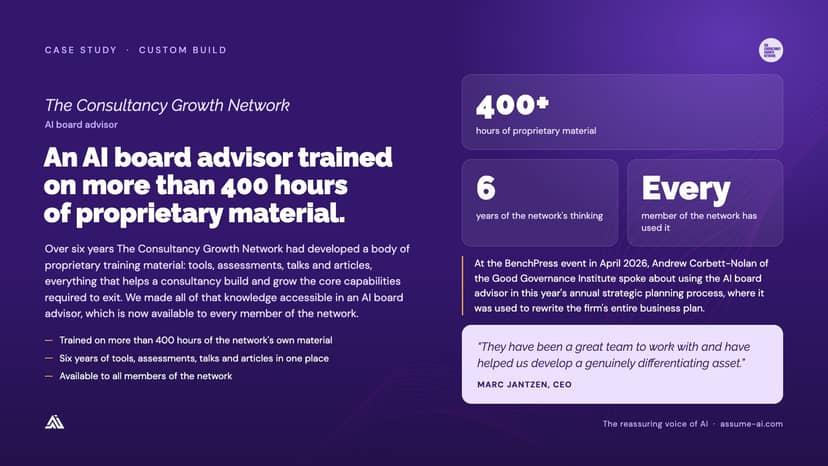
- Hours of a firm's own material in one AI advisor
- 400+
- Special categories of personal data under UK GDPR
- 9
- AI governance implementation, from
- £3,000
Firms we have built with















What does AI for an HR consultancy actually involve?
An HR consultancy sells judgement: knowing how a process would look to a tribunal, how to word a difficult letter, which policy a growing client actually needs. A good part of the week, though, goes on work that is not judgement at all. Adapting the same handbook for the fifth client this month, writing a proposal from a blank page, keying a new client's details into the CRM, the practice system and the shared drive, turning survey responses into a report. That is the work AI does well, and it is where the time comes back first.
HR work also carries more risk than most consulting. You hold your clients' employee data, much of it about health, absence, grievances and discipline, and your advice is relied on when things go wrong. So the order matters. We start by finding where your hours go and putting a cost against each opportunity, ranked. We then put the governance in place: the policies, impact assessments and controls that say what may and may not go into an AI tool. Only then do we design and build. You can take all three stages with us, or take one and run the rest yourself.
The rest of this guide covers the four places AI tends to pay back in an HR consultancy, the risks specific to employee data and employment law, and the lightest ways to start. If you run a broader practice, our guide to AI for consultancies covers the general case, and AI for professional services covers firms that answer to a professional body.
- Step 01
Find and cost
Where the hours go, with a cost against each opportunity, ranked.
- Step 02
Govern
Policies, controls and training, so AI is used safely and consistently.
- Step 03
Build
Production-grade AI, built inside your firm and owned by you.
Where does AI help an HR consultancy first?
Four kinds of work come up again and again. None of them asks you to hand judgement to a machine; each one removes the assembly work around it.
Policy and handbook drafting
Most HR consultancies keep a library of policies, contracts and template letters that they adapt for each client. An AI assistant set up over your own templates can produce a first draft of a client's absence policy or handbook section in your house wording, point out where the client's circumstances differ from the template and list the clauses a consultant must check. The consultant still signs it off; what goes is the hour of copying, pasting and hunting for the last client's name. For Hillbreak, a specialist advisory firm, we built six custom Claude skills, including writing in the house voice, and took two worked use cases from brief to finished document.
Employment law research, with caveats
AI is good at summarising long guidance, comparing a client's policy with a requirement you give it and drafting the questions to ask before you advise. It is not a reliable source of law. In June 2025 the High Court, ruling on lawyers who had put fictitious cases before it, said freely available generative AI tools such as ChatGPT are not capable of conducting reliable legal research, and that lawyers who use them have a professional duty to check the research against authoritative sources. Your clients will hold you to the same standard. The safe pattern is to point the tool at material you trust, such as legislation.gov.uk, official guidance and your own know-how, and to treat every citation as unverified until a person has read it.
Proposals and client reports
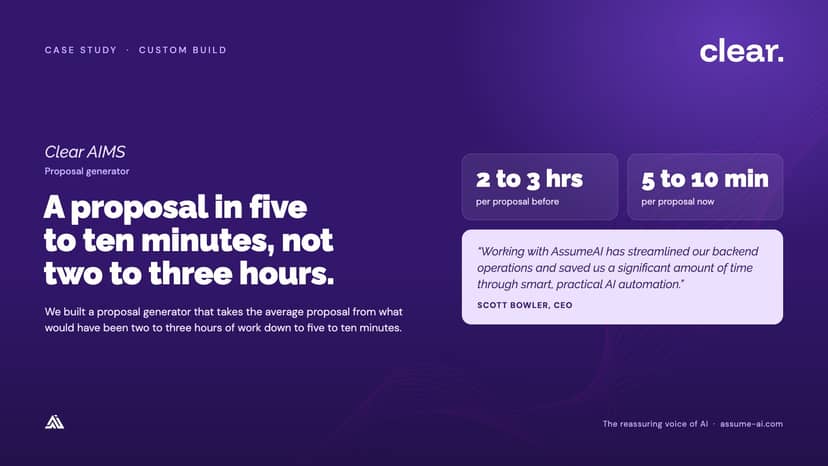
Proposals are the clearest early win in any consultancy. For Clear AIMS we built a proposal generator that takes the average proposal from two to three hours of work down to five to ten minutes. The same approach suits the reports an HR consultancy writes after an engagement survey or an audit. At Coaching Without Borders, a coaching and leadership training firm, survey responses are now filed automatically and turned into a finished slide report with the statistics and the analysis.
Client onboarding
Every new client means the same set-up: a record in the CRM, a project in the practice system, a folder structure, an engagement letter and a request for the documents you need. At Coaching Without Borders one form now sets up a new project in four systems in about ninety seconds, and another converts a won project from sales to delivery and archives the original. An HR consultancy's onboarding has the same shape with one extra rule: the employee data a client sends should land in the right place with the right access, not in someone's inbox.
What have similar firms achieved with AI so far?
We publish every figure we quote, with the client's name. Our case studies come from consulting, coaching and advisory firms rather than from HR consultancies, but the work is the same work: proposals, reports, project set-up and putting a firm's own know-how where its people can use it.
The Consultancy Growth Network had built six years of proprietary tools, assessments, talks and articles. We made all of that knowledge accessible in an AI board advisor trained on more than 400 hours of the network's material, now available to every member. For an HR consultancy the equivalent is your own know-how: the precedents, guidance notes and model answers that today live in a few senior heads and a shared drive.
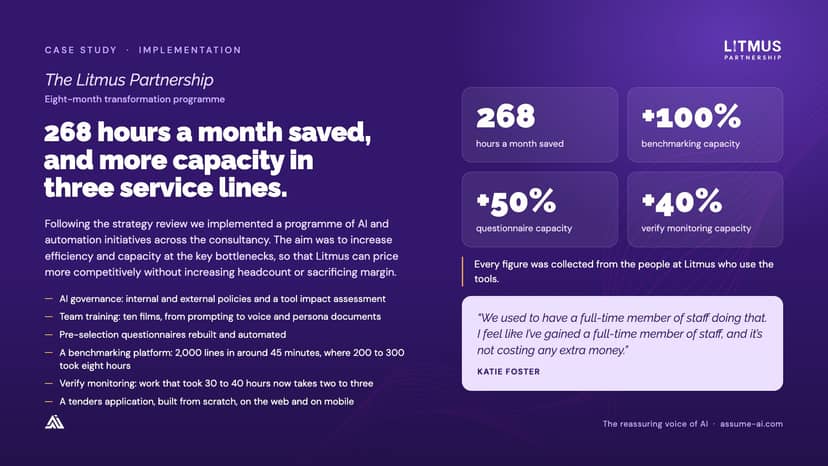
At The Litmus Partnership an eight-month programme of AI and automation now saves 268 hours a month, and every figure was collected from the people at Litmus who use the tools. Katie Foster put it simply: “I feel like I’ve gained a full-time member of staff, and it’s not costing any extra money.”
How do you keep employee data safe when using AI?
Employee data is the main risk in AI for HR consultancies, and it is mostly a governance problem rather than a technical one. UK GDPR sets out nine special categories of personal data, including health, racial or ethnic origin, religious or philosophical beliefs, trade union membership and sexual orientation, and they need extra justification and protection. Sickness absence records and occupational health reports are health data; grievance files, disciplinary files and diversity monitoring often contain special category data too. Criminal offence data is not a special category, but it is subject to similar rules.
The practical rules are simple to state. Use an enterprise AI platform whose terms keep your data out of model training, configured to your own policies for access, permissions and retention. Do not let consultants paste client employee data into personal accounts of free tools. Put in only what the task needs, removing names where you can. Assess each tool before it touches personal data, with a data protection impact assessment where the risk is high. Our Enterprise AI Deployment puts Claude Cowork or ChatGPT Enterprise on EU-based data hosting, configured to your data governance policies.
Decisions about people need particular care. Since 5 February 2026 the Data (Use and Access) Act 2025 has replaced the UK GDPR rules on automated decision-making: a decision is based solely on automated processing where there is no meaningful human involvement, and significant decisions based on special category data cannot be taken that way except in narrow cases. Recruitment is where this bites first. In November 2024 the ICO reported on audits of AI recruitment tools that found some inferring gender and ethnicity from candidates' names, some letting recruiters filter out people with certain protected characteristics, and some keeping candidate data indefinitely; it made almost 300 recommendations. If clients ask you about AI in hiring, performance or redundancy selection, those findings and the Equality Act 2010 are where the advice starts.
Our AI governance implementation gives you internal AI policies for your consultants, external AI policies for your clients and partners, impact assessments, and audit trails including a risk register and an incident log, typically in two to four weeks. If you do not have a policy yet, the governance template we use with clients is free on our resources page.
Describe the defined business use case for this tool. What problem does it solve, and what outputs will it produce?
| Non-AI alternatives considered | |
|---|---|
| Why AI is more appropriate than alternatives | |
| Is this use of AI proportionate to the task? |
 Governance pack · Template
AI Tool Impact Assessment
Complete one per AI tool. Retain as a governance record.
| Tool name | |
|---|---|
| Vendor or provider | |
| Version or model | |
| Date of assessment | |
| Assessor | |
| Business owner | |
| Date of first use | |
| Next review date |
- Employee data kept out of free tools
- You own all of it, code included
- EU-based data hosting
- UK GDPR and the 2025 data act
What should an HR consultancy not use AI for?
Four lines are worth drawing before anyone opens a tool.
Do not let AI take a decision about a person. Drafting the letter is fine; deciding the outcome is not. Keep a named consultant accountable for every recommendation, and make the human review a real one rather than a click-through, because meaningful human involvement is now the test the law applies.
Do not cite what nobody has read. A case, a statutory reference or a tribunal outcome produced by an AI tool is a lead, not a source, until someone has opened it on an authoritative site.
Do not paste identifiable employee data into a personal or free account. Most leakage is not a hack; it is a well-meaning consultant in a hurry.
And do not ban AI outright. A blanket ban does not work; it just pushes usage underground, where you cannot see what goes where. Clear guardrails let people use AI with confidence.
- AI deciding about a person
- Citations nobody has checked
- Employee data in free tools
- A blanket ban
Where should an HR consultancy start with AI?
Many HR consultancies are small firms with nobody technical in house. For a firm of that size the barrier is rarely the money; it is not having anyone who can build. That is our part, and afterwards we train your team, hand over the documentation and leave a roadmap you can run without us.
If you would like a benchmark first, the free AI maturity assessment is nine questions and about two minutes, built for professional services firms of 20 to 200 staff, with your scored report in your inbox immediately. After that, these are the lightest ways in.
AI governance implementation
If your consultants already use AI with no framework around them, start with AI governance implementation: from £3,000, typically two to four weeks. For a firm that holds its clients' employee data, this is usually the right first step.
AI Priorities Workshop
The AI Priorities Workshop, from £4,000, runs one pain point workshop with your senior team and a second with the people doing the day-to-day work, then leaves you a concise roadmap of the initiatives to focus on first.
Tailored AI team training
Tailored AI team training, from £5,000, covers Claude, Cowork, Gemini and Prompt Engineering Fundamentals, built around your real work rather than generic demos. For an HR team that might be drafting from your own templates, summarising guidance and checking a draft letter.
30-day implementation sprint
If you already know the bottleneck, a 30-day implementation sprint, from £6,000, spends one week agreeing what to build and three weeks rolling it out: a proposal generator, an onboarding form or a drafting assistant over your own policy library.
What does AI consulting cost for an HR consultancy?
Every service has a published starting price, and the prices are the same for an HR consultancy as for any other firm. We will not quote a build before we know where your hours go, because the honest number depends on it. You sign off exactly what gets built, with the number and the return it is based on in front of you. If a 30-day sprint is not live and delivering value in 30 days, we keep working at no extra cost until it is.
| Service | Investment |
|---|---|
| AI Priorities WorkshopTwo pain point workshops and a concise roadmapTwo workshops, plus a roadmap | From £4,000 |
| AI Strategy ReviewSurveys, interviews, a tech stack review and five documentsAbout six weeks | From £12,000 |
| AI Governance ImplementationPolicies, impact assessments and audit trails2 to 4 weeks | From £3,000 |
| Tailored AI Team TrainingWorkshops across Claude, Cowork, Gemini and moreOne-off or a sustained programme | From £5,000 |
| 30-Day Implementation SprintOne use case, built and deployedAbout four weeks | From £6,000 |
| 90-Day Implementation SprintSeveral workflows built, deployed and embeddedAbout twelve weeks | From £15,000 |
| Enterprise AI DeploymentClaude Cowork or ChatGPT Enterprise, with six to twelve agents and skillsAgreed when scoped | £20,000 ex VAT |
| Managed ServiceHalf, one or two engineers embedded in your firmMonthly | From £5,500 per month |
Who will actually do the work?
AssumeAI is founder-led from end to end. Rupert Wiseman, Managing Director and Principal AI Consultant, studied Law at Exeter and worked in corporate finance before co-founding the business; his legal background brings a rigorous focus on safety, governance and risk controls from day one. Hugh Dowling, Head of Development, completed a Master's in Software Engineering and makes sure everything we build is designed to operate in a secure, scalable, commercial environment.
Behind the founders is an associate network of over ten AI consultants and AI engineers, so the work is never waiting on one person. You can meet the team on our about page and read our weekly writing on AI adoption on the blog.


Where do the legal points in this guide come from?
This guide is general information for HR consultancies, not legal advice. The legal points were checked against these sources on 21 October 2026.
- ICO: What is special category data?
- Data (Use and Access) Act 2025, section 80: automated decision-making
- The Data (Use and Access) Act 2025 (Commencement No. 6) Regulations 2026, SI 2026/82
- ICO, 6 November 2024: ICO intervention into AI recruitment tools leads to better data protection for job seekers
- R (Ayinde) v London Borough of Haringey, High Court, 6 June 2025, EWHC 1383 (Admin)
- Equality Act 2010, section 4: the protected characteristics
Questions
Can we use ChatGPT or Claude for employment law research?
For finding and summarising material, yes; as a source of law, no. Point the tool at material you trust and check every case and statutory reference against an authoritative source before it reaches a client. In June 2025 the High Court said freely available generative AI tools such as ChatGPT are not capable of conducting reliable legal research, and that lawyers who use them have a professional duty to check the research against authoritative sources.
Is it lawful to put client employee data into an AI tool?
It can be, with the right platform and the right rules: a lawful basis, an enterprise platform configured to your own policies for access, permissions and retention, as little personal data as the task needs, and an impact assessment before anything high risk. Health data and the other special categories under UK GDPR need extra justification and protection. A personal account on a free tool is the wrong place for any of it.
Can AI screen CVs or score performance for our clients?
It can assist, but a person should take the decision. Since 5 February 2026, UK GDPR treats a decision as based solely on automated processing where there is no meaningful human involvement, with tighter limits where special category data is involved. The ICO's 2024 audits of AI recruitment tools also found tools that inferred gender and ethnicity from names and kept candidate data indefinitely. We would start any such work with an impact assessment.
Do you have case studies from HR consultancies?
The case studies we publish come from consulting, coaching and advisory firms, including Clear AIMS, Coaching Without Borders, The Litmus Partnership, Hillbreak and The Consultancy Growth Network. The work an HR consultancy needs most, proposals, reports, client onboarding, governance and putting your own know-how to work, is the same work we built for them. Every project, with its figures, is on our work page.
What is the least expensive way to start?
The free AI maturity assessment: nine questions, about two minutes, and a scored report benchmarked against comparable firms. The lightest paid engagements are AI governance implementation, from £3,000, which is usually the right first step for a firm that holds its clients' employee data, and the AI Priorities Workshop, from £4,000, which gives you two pain point workshops and a concise roadmap.