
AI for management consultancies.
AI for management consultancies means using AI on the work that surrounds the advice: writing proposals, researching and analysing, finding what the firm already knows, and running the practice. Done well, it lets a boutique or mid-sized consulting firm deliver more without adding headcount and hold its fees under pressure, while the judgement clients pay for stays with the consultants. AssumeAI is a UK, founder-led AI consultancy and AI engineering firm that builds this for consulting firms, from a pair of prioritisation workshops to working systems.
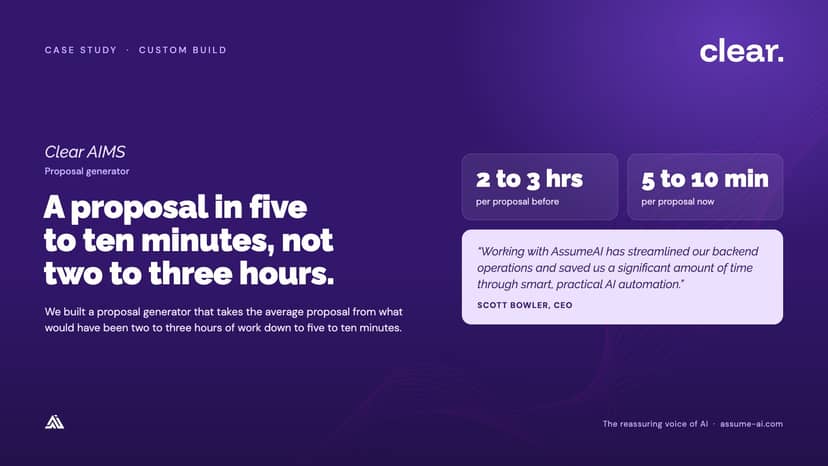
- Minutes, at most, per Clear AIMS proposal, once two to three hours
- 10
- Benchmarking lines in about 45 minutes at Litmus
- 2,000
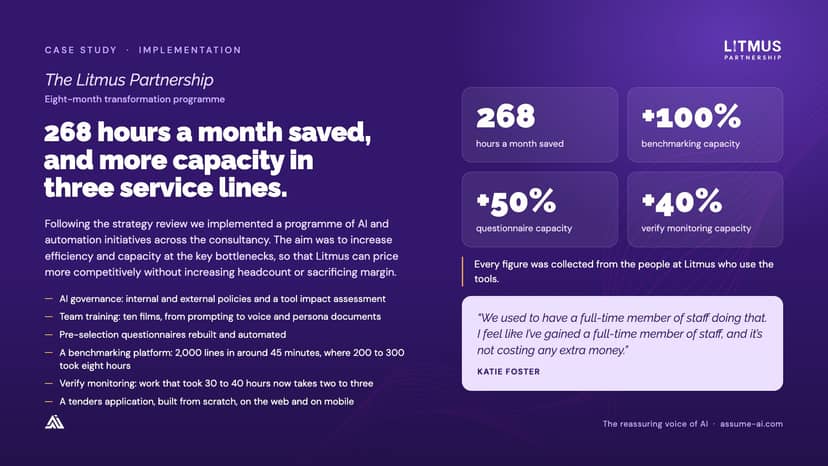
- Hours a month saved at The Litmus Partnership
- 268
- Hours of IP in one AI board advisor
- 400+
Firms we have built with
















How is AI changing the management consulting model?
Management consulting has long been sold on leverage: a partner wins the work and owns the answer, and a team of consultants and analysts does the research, the data work and the first drafts underneath. A good part of what sits at the base of that pyramid is exactly the work generative AI now does quickly: gathering and summarising sources, cleaning and comparing data, and producing a first version of a slide, a report or a statement of work.
That cuts both ways. A firm that takes the repetitive work out of delivery can serve more clients with the same team, or price more keenly and keep its margin. A firm that does not will find its clients asking why the same analysis still takes the same number of days. The firms we work with tend to feel the pressure in four places at once: the hours inside delivery, the unbilled time spent on proposals, knowledge that only exists in old decks and in people's heads, and fee conversations in which AI is now part of the question.
The evidence also says where to be careful. In a field experiment published by Boston Consulting Group in September 2023, run with academics from Harvard Business School, MIT Sloan, Wharton and the University of Warwick, more than 750 BCG consultants were given GPT-4. On a creative product innovation task, around 90% of them improved, and the group reached a level about 40% higher than the control group. On a business problem-solving task that the tool was not suited to, those using GPT-4 did 23% worse than those working without it. For a consulting firm the lesson is practical: AI raises the floor on preparation and drafting, and a consultant still has to own the conclusion.
- Junior hours the pyramid sells
- Proposals written at the firm's own cost
- Knowledge locked in old decks
- Clients asking what AI saves them
How can a consultancy use AI to write proposals faster?
Proposals are where most consulting firms feel the hours first, because they are written before anyone has paid. They are also unusually well suited to AI: every firm has a library of past proposals, case studies, team biographies and pricing logic, and most new proposals reuse a large part of it. The work is finding the right pieces and adapting them to the brief, which is what a proposal generator built over your own material does.
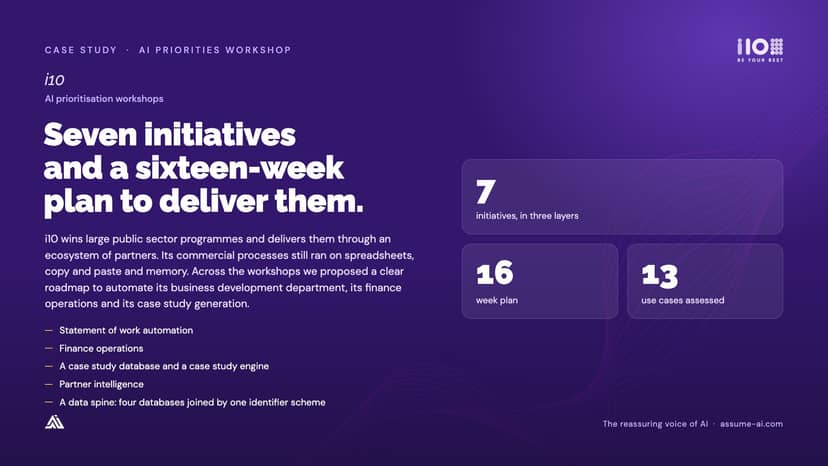
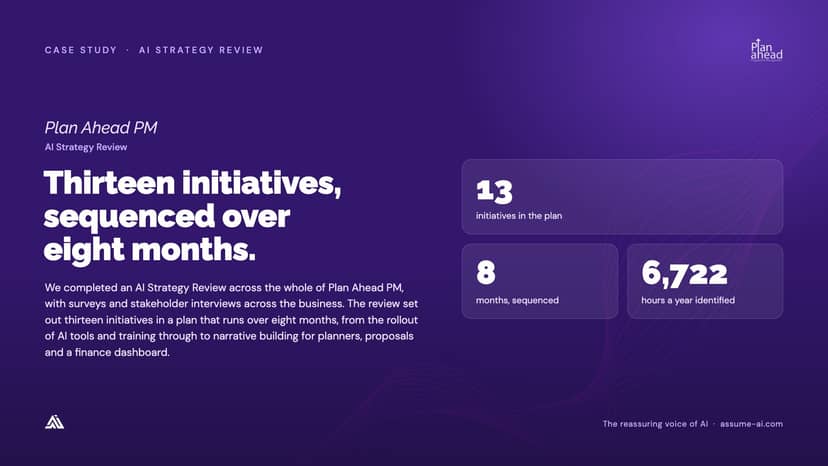
The proposal generator we built for Clear AIMS takes the average proposal from what would have been two to three hours of work down to five to ten minutes. Scott Bowler, its CEO, said it “saved us a significant amount of time through smart, practical AI automation”. At i10, a firm that wins large public sector programmes and delivers them through an ecosystem of partners, the commercial process still ran on spreadsheets, copy and paste and memory; the roadmap from our workshops includes statement of work automation, a case study database and a case study engine, and partner intelligence. The strategy review for Plan Ahead PM put proposals into a thirteen-initiative plan alongside narrative building for planners and a finance dashboard.
For firms that bid formally, the same idea applies to tenders and pre-selection questionnaires. At The Litmus Partnership we rebuilt and automated the pre-selection questionnaires, which added 50% to the team's capacity for them, and built a tenders application from scratch for the web and for mobile.
The rule we hold to: the system drafts from your approved material, and a person who knows the client signs off every proposal that leaves the firm.
Where does AI add leverage inside consulting delivery?
Inside an engagement, the leverage comes from the analytical grind: pulling data out of documents and spreadsheets, matching and comparing it, checking it and writing up the first view. That is where a junior team's days go, and where an analyst with the right tools can now do the work of several.
The clearest example is The Litmus Partnership. Our two-week strategy review identified twenty-six initiatives and 9,672 hours a year across seven departments. The eight-month programme that followed built a benchmarking platform that handles 2,000 lines in around 45 minutes, where 200 to 300 lines used to take eight hours, and turned monitoring work that took 30 to 40 hours into two to three. Benchmarking capacity doubled. The firm now saves 268 hours a month, and every figure was collected from the people at Litmus who use the tools. Katie Foster put it simply: “I feel like I’ve gained a full-time member of staff, and it’s not costing any extra money.”
Desk research and synthesis are the other everyday use. General AI assistants are good at a first pass over sources, and poor at knowing which source a partner would trust. We set teams up with house prompts, skills and checklists so the first pass is consistent and the checking is built in; for a whole firm that is usually tailored AI team training or an enterprise deployment with six to twelve agents and skills built around the work the teams actually do.

The Litmus Partnership
“AssumeAI are a pleasure to work with and delivered a clear, concise and practical AI strategy review. Within a short timespan, they demonstrated a deep understanding of our business and articulated a prioritised roadmap which we can now execute, with sensible governance, training and risk controls built in.
We look forward to continuing to work with Hugh and Rupert to drive differentiation and efficiencies throughout our consultancy with AI and automation.”
How should a consulting firm manage its knowledge with AI?
A management consultancy's real asset is what it has learned: frameworks, diagnostics, past reports, benchmarks and the judgement written into them. In most firms that knowledge is spread across shared drives and inboxes, and the fastest way to find it is still to ask the partner who did the last similar job.
The large firms saw this early. McKinsey announced Lilli, an internal generative AI assistant, in August 2023, built to search more than 100,000 internal documents and interview transcripts. A boutique cannot match that library, but it does not need to. What it needs is its own material, organised and answerable, and that is now within reach of a firm of twenty people.
The Consultancy Growth Network had built six years of proprietary tools, assessments, talks and articles on how a consultancy builds the capabilities it needs to grow and exit. We made all of it accessible in an AI board advisor trained on more than 400 hours of the network's material, now available to every member. Marc Jantzen, its CEO, said we helped them “develop a genuinely differentiating asset”.
The same approach works inside a firm: an assistant over your methods and past work that a new consultant can question on day one, with answers that point back to the source document so they can be checked.
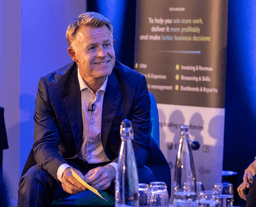
The Consultancy Growth Network
“We have been working with Rupert and Hugh from AssumeAI to develop an on demand AI board coach trained on over 400 hours of our video content. They have been a great team to work with and have helped us develop a genuinely differentiating asset. They clearly know what they are talking about with AI and we look forward to our continuing work together.”
What does AI mean for consulting fees and pricing?
If a piece of analysis that took a week now takes a day, a day rate stops describing the value of the work. That is the uncomfortable part of AI for a management consultancy, and the firms that handle it well decide in advance where the saved time goes rather than letting clients decide for them.
There are three broad choices, and most firms use a mix. You can keep the price and put the saved hours into more depth, more options and more time with the client. You can price more keenly to win more work at the same margin, which was the stated aim of the Litmus programme: more efficiency and capacity at the key bottlenecks, so that Litmus can price more competitively without increasing headcount or sacrificing margin. Or you can move more work to fixed fees and outcomes, so the efficiency stays with the firm that created it.
Whichever you choose, you need to know where your hours actually go before you can price around them. That is why our work starts by finding the hours and putting a cost against each opportunity, ranked, before anything is built. The free AI maturity assessment is a two-minute first look, and our post on where AI pays back first in a consulting firm covers the opportunities we see most often.
How can a boutique consultancy compete with large firms using AI?
Boutique consultancies have always competed on seniority, specialism and speed. AI strengthens all three, provided the firm builds around its own material rather than relying on the same general tools as everyone else.
Your knowledge, answerable
A boutique's methods and past work are its edge. Put AI over them and every consultant can draw on the firm's whole body of thinking, which is what McKinsey built Lilli to do, and what The Consultancy Growth Network now offers its members.
Proposals from your own material
A boutique often loses bids it could win simply because it cannot produce the volume of tailored proposals a larger firm can. A generator built over your past proposals and case studies, as at Clear AIMS, closes much of that gap.
Analysis at a larger firm's scale
The analysis a large team does by hand can be done by a small team with the right tools, as the Litmus benchmarking platform shows. That lets a partner-led firm take on larger pieces of work without changing the senior attention clients chose it for.
How do consultancies use AI without breaching client confidentiality?
Management consultants handle board papers, financials and plans that clients share with nobody else, often under a non-disclosure agreement. Consultants pasting that material into whichever consumer tool they found last week is the risk to close first; a blanket ban does not close it, it just pushes usage underground.
AI governance implementation, typically two to four weeks and from £3,000, gives you internal AI policies for your teams, external AI policies you can share with clients and partners, impact assessments for what you deploy, and audit trails including a risk register and an incident log. The Litmus programme included the same groundwork: internal and external AI policies and a tool impact assessment.
On the data itself, we build inside your existing infrastructure, you own all of it, code included, and enterprise platforms run on EU-based data hosting configured to your own policies for access, permissions, retention and data handling. If you do not have a policy yet, the governance template we use with clients is free.
Describe the defined business use case for this tool. What problem does it solve, and what outputs will it produce?
| Non-AI alternatives considered | |
|---|---|
| Why AI is more appropriate than alternatives | |
| Is this use of AI proportionate to the task? |
 Governance pack · Template
AI Tool Impact Assessment
Complete one per AI tool. Retain as a governance record.
| Tool name | |
|---|---|
| Vendor or provider | |
| Version or model | |
| Date of assessment | |
| Assessor | |
| Business owner | |
| Date of first use | |
| Next review date |
- Internal and external AI policies
- An impact assessment for each tool
- Built inside your infrastructure
- EU-based data hosting
Where should a management consultancy start with AI?
Start with where the hours go, not with a tool. In order of commitment:
- The free AI maturity assessment: nine questions, about two minutes, built for professional services firms of 20 to 200 staff, with a scored report benchmarked against comparable firms.
- The AI Priorities Workshop, from £4,000: one pain point workshop with your senior leadership, a second with the people doing the day-to-day work, and a concise roadmap. i10 came out of its workshops with seven initiatives and a sixteen-week plan, from thirteen use cases assessed.
- The AI Strategy Review, from £12,000 and about six weeks: surveys, stakeholder interviews and a full review of your tech stack, ending in five practical documents, among them an implementation roadmap, a risk assessment, an audit report and an executive presentation.
- A 30-day implementation sprint, from £6,000, if you already know the bottleneck: one week to agree what to build and three weeks to roll it out. If it is not live and delivering value in 30 days, we keep working at no extra cost until it is.
Our wider guide to AI for consultancies covers specialist consultancies, building versus buying, timelines and the full price list, and the guide to AI for professional services covers firms that answer to a chartered or professional body. We also teach this subject: we have run workshops for master's students at Green Templeton College, University of Oxford, on how AI is practically supporting consulting firms.
Sources for the external facts on this page
- Boston Consulting Group, How People Can Create and Destroy Value with Generative AI, 21 September 2023.
- Maginative, McKinsey Unveils Lilli, Its Own Generative AI Assistant, 16 August 2023.
- Every AssumeAI figure on this page comes from the linked case studies, where the client and the work are described in full.
Questions
How are management consultancies using AI?
Mostly on the work around the advice rather than the advice itself: drafting proposals and statements of work from the firm's own templates, desk research and data analysis inside delivery, finding answers in years of past reports and frameworks, and the back office of project set-up, finance and reporting. The judgement a client pays for stays with the consultants; AI takes on the preparation that surrounds it.
Will AI replace junior consultants?
It changes what junior consultants spend their time on. Much of the work a leverage model sells by the hour, such as gathering data, cleaning it and building a first draft, is the work AI does well. The firms that benefit move that time into analysis, client contact and quality checking, which is also how juniors learn the judgement the firm sells. Research with BCG consultants found that AI made output worse on a task it was not suited to, so a person still has to own every conclusion.
Can a boutique consultancy compete with the large firms on AI?
Yes, and often faster. The large firms have built internal AI platforms over their own knowledge, but a boutique has fewer systems, fewer approvals and partners close to the work, so it can put AI over its own frameworks and templates in weeks. The Consultancy Growth Network's AI board advisor, trained on more than 400 hours of its own material, is the kind of asset a small firm can own outright.
Can we use AI on client material covered by an NDA?
Only with the right platform and the right rules. Consumer tools are the wrong place for client material. We build inside your existing infrastructure, deploy enterprise platforms on EU-based data hosting configured to your data governance policies, and write internal AI policies for your team and external AI policies you can show clients, with impact assessments and audit trails behind them.
What does AI cost for a management consultancy?
Every service has a published starting price. The free AI maturity assessment costs nothing; the AI Priorities Workshop starts from £4,000; AI governance implementation from £3,000; a 30-day implementation sprint, which puts one working solution live, from £6,000; and the AI Strategy Review, about six weeks, from £12,000. We will not quote a build before we know where your hours go.