What the media and business press still get wrong about this AI transition
By AssumeAI · Published Jun 15, 2026
What the media and business press still get wrong about this AI transition
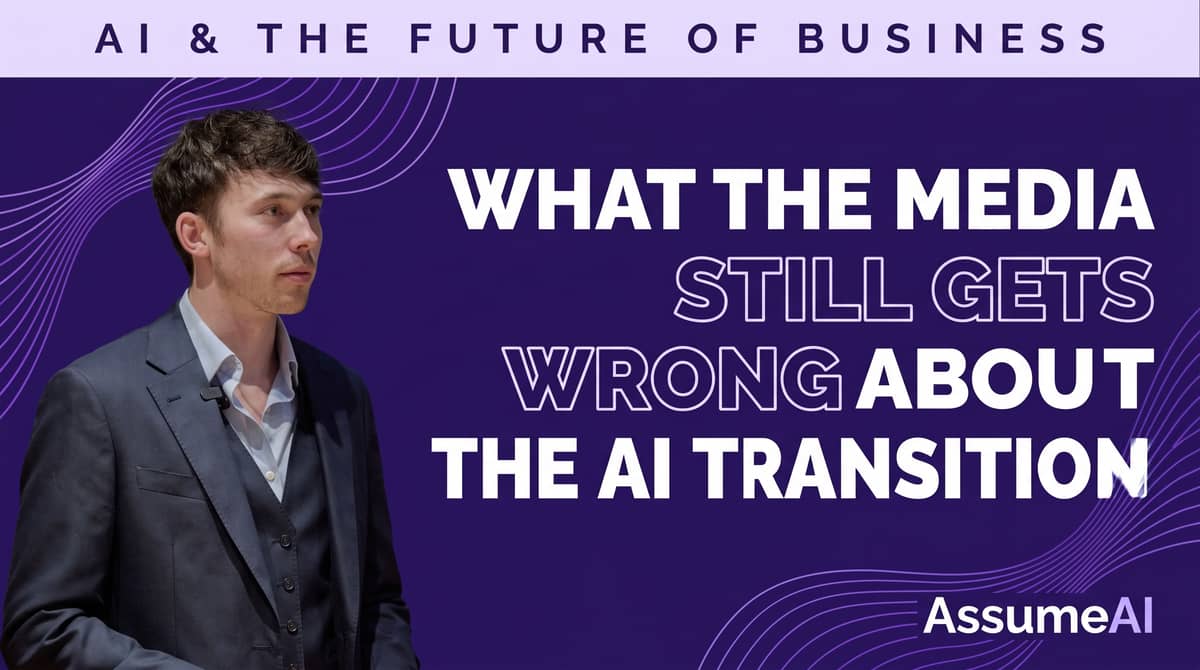
Everything in the media is polarised. That polarisation is not merely an aesthetic problem with journalism; it is creating a genuine and widening misunderstanding about what AI actually is, what it can do, and what businesses should reasonably expect from it.
The coverage falls into two camps, and both are wrong.
On one side, you have the breathless evangelism: AI is coming for every job, every industry, every assumption you hold about how work gets done. Transformation is imminent. Weeks, not years. On the other side, you have the sceptics and the contrarians, who have looked at the consumer version of ChatGPT, found it capable of writing a mediocre birthday card, and concluded that the whole thing is a sophisticated autocomplete dressed up in venture capital money.
Neither position is accurate. And the tragedy is that both, in their own way, cause real damage.
The watershed moment has already happened
Think about the day the first iPhone was released. At the time, the headlines debated whether it was a gimmick, whether people really needed the internet in their pocket, whether it would ever rival the BlackBerry. What those headlines missed entirely was the more important question: not what the iPhone could do on day one, but what the world would look like once that capability was in everyone's hands and had fifteen years to compound.
We are at that exact moment with AI.
The watershed has happened. The capability threshold crossed in the last two to three years is not comparable to the incremental software improvements that came before it. Something genuinely changed. The question is not whether AI represents a meaningful technological shift. It does, plainly and verifiably. The question that actually matters is: what does the iPhone 17 of AI look like in fifteen to twenty years? What industries, roles, and assumptions get rebuilt entirely once this technology has had time to mature, spread, and compound in ways we cannot yet fully anticipate?
That is the conversation businesses should be having. Instead, the media has reduced it to a binary: transformative or overhyped. Both framings miss the point.
AI as a lever, not a magic wand
Like any technology, AI acts as a lever. It amplifies the output you can extract from a given input. It does not replace the input, the judgement, or the strategic direction. A business with unclear processes, poor data, and no real understanding of where its bottlenecks sit will not be transformed by AI adoption. It will be confused by it, at scale, slightly faster than before.
A business that understands its own operations, knows where time is being lost, and has people willing to engage seriously with new tools can move meaningfully. AI consulting and AI implementation work best not when they are treated as a silver bullet, but when they are applied to specific, well-defined problems where the technology's current capabilities are a genuine fit.
That distinction matters enormously for any organisation considering AI transformation. The value is real. The timelines are not what the headlines suggest.
Why the extremes are dangerous, not just irritating
The polarised headlines produce a specific and observable problem in the market. Some businesses arrive at conversations about AI development and AI adoption expecting transformation in a matter of days or weeks. They have read that AI can automate entire departments, and they want to know why their department has not been automated yet. They have unrealistic timelines, vague objectives, and a growing sense of disappointment when reality arrives.
Others, equally misled, have concluded that AI is simply the consumer version of ChatGPT and nothing more. They have tried it, found it imprecise or generic, and moved on. They are not hostile to technology in principle; they simply do not believe that what they have seen bears any resemblance to something that could add value to their specific work. That scepticism, in many cases, is entirely rational given what they have been exposed to.
The divide between these two groups is the problem. The over-believers risk burning budget, goodwill, and internal credibility on poorly scoped initiatives. The disbelievers risk ceding ground to competitors who are quietly building genuine operational advantages through AI integration. Neither outcome is inevitable, but both are common, and both trace back to a business press that has chosen drama over precision.
What a more honest conversation looks like
AI is not a gimmick, and it is not an overnight fix. It is infrastructure, of a kind, and it rewards the same quality of thinking that any serious infrastructure investment demands. The organisations extracting genuine value from AI right now are not doing so because they moved fastest or spent most. They are doing so because they identified specific, bounded problems, engaged the right expertise in AI consulting and implementation, built something, measured it, and iterated.
The iPhone did not transform commerce, communication, and culture on the day it launched. It did so over a decade and a half, as developers, businesses, and users found new ways to use what was now possible. We are at day one of that same arc with AI. The businesses that will benefit most are those who understand that, resist the noise on both sides, and start asking the right questions now.
That is not a particularly exciting story to run on the front page. But it is the one that actually helps businesses make good decisions, and it is the conversation that AI transformation, done properly, is built on.
#AIImplementation #AIConsulting #AIAdoption #Cybersecurity #AISecurity #SME #SoftwareSecurity #AIGovernance